Showing posts with label Ireland. Show all posts

Friday, October 28, 2016

New Book: Ireland's Immortals: A History of the Gods of Irish Myth by Mark Williams


Ireland's Immortals: A History of the Gods of Irish Myth by Mark Williams is a new book released this week. If you are interested in Irish folklore, this is a must for you.

This is a hefty tome of nearly 600 pages. I received a review copy but haven't had the time to read it closely yet. However, I have read some passages and the first impression I have is, "Wow, I didn't know that about ____." Fill in the blank to whatever I was reading on the page.

The second impression is "This is surprisingly very readable for how scholarly and informational it is." Because, yes, I, too, struggle with twenty-five cent words in many academic texts. If I paused to consider a sentence while I was reading this, it wasn't to parse the meaning of the sentence but to contemplate that meaning. The tone is even conversational with first person perspective offered which may be off-putting to some but which I find refreshing since that is the way I approach much of what I write. Reading this book makes you think that Mark Williams would make a fascinating dinner companion.

I mean really, here is a paragraph from the first page of chapter 1:

The earliest written evidence for native gods comes from early Christian Ireland, not from the pagan period; this is a pivotal fact which must be emphasized. Christianity did not entirely consign the pagan gods to the scrapheap, but the consequences of its arrival were dramatic and affected Irish society on every level. Pagan cult and ritual were discontinued, and a process was set in motion that eventually saw a small number of former deities reincarnated as literary characters. Christianity—intrinsically a religion of the book—enabled the widespread writing of texts in the Roman alphabet. Some of these have been transmitted to the present, with the paradoxical upshot that we owe our ability to say anything at all about the ‘personalities’ of Ireland’s pre-Christian gods to the island’s conversion.

That's fascinating and highly readable stuff if this is the type of stuff you like to read. Which if you are here, you most likely do.

There is also an excellent index which is what I used to look up passages with names and concepts I am familiar with--Yeats is represented abundantly but I also found Lady Jane Wilde--some of who's Ancient Legends, Mystic Charms, and Superstitions of Ireland I have been reading recently, she was a folklorist of sorts and mother to Oscar Wilde--as well as other writers such as James Stephens and Walter Sharp.

So if this topic interests you at all, I'd consider this one to be a new important addition to your library. It's earned a place on my shelves.

Book description:

Ireland’s Immortals tells the story of one of the world’s great mythologies. The first account of the gods of Irish myth to take in the whole sweep of Irish literature in both the nation’s languages, the book describes how Ireland’s pagan divinities were transformed into literary characters in the medieval Christian era—and how they were recast again during the Celtic Revival of the late nineteenth and early twentieth centuries. A lively narrative of supernatural beings and their fascinating and sometimes bizarre stories, Mark Williams’s comprehensive history traces how these gods—known as the Túatha Dé Danann—have shifted shape across the centuries, from Iron Age cult to medieval saga to today’s young-adult fiction.

We meet the heroic Lug; the Morrígan, crow goddess of battle; the fire goddess Brigit, who moonlights as a Christian saint; the mist-cloaked sea god Manannán mac Lir; and the ageless fairies who inspired J.R.R. Tolkien’s immortal elves. Medieval clerics speculated that the Irish divinities might be devils, angels, or enchanters. W. B. Yeats invoked them to reimagine the national condition, while his friend George Russell beheld them in visions and understood them to be local versions of Hindu deities. The book also tells how the Scots repackaged Ireland’s divine beings as the gods of the Gael on both sides of the sea—and how Irish mythology continues to influence popular culture far beyond Ireland.

An unmatched chronicle of the Irish gods, Ireland’s Immortals illuminates why these mythical beings have loomed so large in the world’s imagination for so long.

Mark Williams is the Simon and June Li Fellow in the Humanities and Tutor in English at Lincoln College, University of Oxford, where he teaches medieval Irish, Welsh, and English literature. He is the author of Fiery Shapes: Celestial Portents and Astrology in Ireland and Wales, 700–1700.

Reviews:

"Scholars and researchers will leap to add [Ireland’s Immortals] to their collections."--Publishers Weekly

Endorsements:

"In 1896, George Russell wrote to W. B. Yeats announcing that ‘the Gods have returned’ to Celtic realms; Mark Williams’s brilliant and powerful book makes good the claim. Learned, discursive, masterfully organized, and often very funny, it illuminates the cults, characters, personalities, and uses of Irish divinities from their emergence in saga, pseudohistory, and folklore through to their exploitation in the Celtic Revival and the literature of fantasy, and their analysis in modern scholarship. This is an important contribution to the history of religion, nationalism, and Gaelic culture; it is also so well written as to be unputdownable."--R. F. Foster, University of Oxford

"With its huge range, constant new insights, colorful material, and sparkling style, this is a truly remarkable book. It should delight a very big readership."--Ronald E. Hutton, University of Bristol

"This magnificent book is a tour de force and a great leap forward in the study of Irish mythology. Mark Williams tells the whole story of the Irish gods, tracing their transformation from ancient times through today. His discussions of medieval sagas, early modern scholarship, Celtic Revival mysticism, and contemporary fiction are equally assured, original, and substantial. Lively and engaging, Ireland's Immortals will appeal to general readers as well as students and scholars."--Ralph O'Connor, University of Aberdeen

"This is an extremely important book. It not only brings together known texts in new and exciting ways but also introduces important new interpretations. Mark Williams is one of the very few people with the expertise and good sense to be able to write a volume like this."--Paul Russell, University of Cambridge

TABLE OF CONTENTS:

List of Illustrations ix
Abbreviations xi
Preface xiii
Guide to Pronunciation xxi

PART ONE

1 Hidden Beginnings: From Cult to Conversion 3
2 Earthly Gods: Pagan Deities, Christian Meanings 30
3 Divine Culture: Exemplary Gods and the Mythological Cycle 72
4 New Mythologies: Pseudohistory and the Lore of Poets 128
5 Vulnerability and Grace: The Finn Cycle 194
6 Damaged Gods: The Late Middle Ages 248

PART TWO

7 The Imagination of the Country: Towards a National Pantheon 277
8 Danaan Mysteries: Occult Nationalism and the Divine Forms 310
9 Highland Divinities: The Celtic Revival in Scotland 361
10 Coherence and Canon: The Fairy Faith and the East 406
11 Gods of the Gap: A World Mythology 434
12 Artgods 489

Acknowledgements 503
Glossary of Technical Terms 507
Conspectus of Medieval Sources 511
Works Cited 517
Index 557

Tuesday, March 17, 2015

Ashey Pelt, An Irish Cinderella for St. Patrick's Day


The following tale is one of the hundreds that appear in Cinderella Tales From Around the World.

Ashey Pelt
Ireland


WELL, my grandmother she told me that in them auld days a ewe might be your mother. It is a very lucky thing to have a black ewe. A man married again, and his daughter, Ashey Pelt, was unhappy. She cried alone, and the black ewe came to her from under the greystone in the field and said, “Don’t cry, go and find a rod behind the stone and strike it three times, and whatever you want will come.”

So she did as she was bid. She wanted to go to a party. Dress and horses and all came to her, but she was bound to be back before twelve o’clock or all the enchantment would go, all she had would vanish. The sisters they did na’ like her; she was so pretty, and the stepmother she kept her in wretchedness just.

She was most lovely. At the party the Prince fell in love with her, and she forgot to get back in time. In her speed a-running she dropped her silk slipper, and he sent and he went over all the country to find the lady it wad fit. When he came to Ashey Pelt’s door he did not see her. The sisters was busy a-nipping and a-clipping at their feet to get on the silk slipper, for the king’s son he had given out that he loved that lady sae weel he wad be married on whaever could fit on that slipper.

The sisters they drove Ashey Pelt out bye to be out of the road, and they bid her mind the cows. They pared down their feet till one o’ them could just squeeze it on. But she was in the quare agony I’m telling you.

So off they rode away; but when he was passing the field the voice of the auld ewe cried on him to stop, and she says, says she—

“Nippet foot, and clippet foot
Behind the king’s son rides,
But bonny foot, and pretty foot
Is with the cathering hides.”

So he rode back and found her among the cows, and he married her, and if they lived happy, so may you and me.

Source: Damant, M. “Folktales. Ashey Pelt and the Three Golden Balls.” Folklore. Vol. 6, No. 3 (Sep. 1895). pp. 305-308. (The tale was told me by a woman now living, a native of Ulster, aged about sixty.—M. Damant)

Tuesday, March 3, 2015

New Release: The Crow of Connemara by Stephen Leigh


(US/UK Links)

The Crow of Connemara by Stephen Leigh is released this week in the US and UK. See The Crow of Connemara (UK Link). This is billed as drawing from mythology and folktales, but nothing specific, but that's enough to warrant a mention here.

Book description:

The Crow of Connemara is a contemporary Celtic fantasy set primarily in Ireland. Picking up threads from ancient Irish mythology and folktales, this story is fantasy, drama, and tragic romance all at once, a tale caught in the dark places where the world of ancient myth intersects our own, where old ways and old beliefs struggle not to be overwhelmed by the modern world.

Colin Doyle is young Irish-American musician from Chicago, whose interest is traditional Irish music. Maeve Gallagher is an Oileánach, an "Islander" from Ireland's west coast. Islanders are outcasts treated with suspicion by the locals, who think them responsible for wild and strange happenings in the area. Colin soon discovers that he's connected to Maeve in ways he never could have imagined.

Saturday, March 17, 2012

Irish Cinderella for St. Patrick's Day


Happy St. Patrick's Day! I shared this post a few years ago and with all things Cinderella on my brain over the last year or so, I had to share again.
Today I thought I would share links to one of the best known Irish Fairy Tales: Fair, Brown and Trembling. It is a Cinderella variant which adds to its popularity, but it is also just a plum good tale. I won't sum it up here, but just provide links. A decent summary is available on Wikipedia, but I recommend going to the tale itself and reading it for it's not much longer than its summary.


First of all, you can read the tale in Celtic Fairy Tales by Joseph Jacobs at Fair, Brown and Trembling as well as Myths and Folklore of Ireland by Jeremiah Curtin at Fair, Brown and Trembling. Jacobs used Curtin as his source, but he also includes some short notes including this reference:
Miss Roalfe Cox is about to publish for the Folk-Lore Society a whole volume of variants of the Cinderella group of stories, which are remarkably well represented in these isles, nearly a dozen different versions being known in England, Ireland, and Scotland.

The forthcoming reference delights me since this book is now well over a hundred years old and available on SurLaLune at Cinderella: 345 Variants by Marian Roalfe Cox. (Someday I might even reformat those pages to the more recent SurLaLune appearance.)

Both Celtic Fairy Tales by Joseph Jacobs and Myths and Folklore of Ireland by Jeremiah Curtin are in print in paper versions although several versions exist on the web, too, for free reading. They are still two of the best collections of Irish fairy tales despite or perhaps because of their age.


The illustrations in this blog are by John Batten for Jacobs' version of the tale, too.


Fair, Brown & Trembling: An Irish Cinderella Story by Jude Daly is a picture book version of the tale, not very old, but out of print.

Monday, March 12, 2012

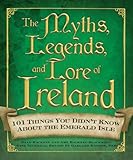
Free eBook: The Myths, Legends, and Lore of Ireland


The Myths, Legends, and Lore of Ireland is free today in Kindle format. Definitely a promo for St. Paddy's but the discount may not last for the entire week.

Book description:

More than 20 million Americans claim some sort of Irish heritage. But how much do you really know about this amazing country? Forget about shamrocks, leprechauns, and all that blarney--this book is a concise and authoritative guide that dispels the myths and tells the true stories of the Irish. Highlights include:

Who St. Patrick really was
The story behind "Sunday Bloody Sunday"
Scandals in the Irish church
Coming to America and the real gangs of New York
The spooky truth behind changelings, leprechauns, and fairies

Complete with an Irish language primer and pronunciation guide, this book is an informative pot of gold for everyone who loves the Irish!

About the Authors

Ryan Hackney received his BA and MA in the History of Science from Harvard University. He has written for Let's Go guides to Britain, Europe, and Ecuador, and he edited Let's Go Ireland. He also got engaged in Ireland (to an American) and has an Irish-Canadian bulldog named Chaucey.

Amy Hackney Blackwell graduated from Duke University with degrees in History and Medieval and Renaissance Studies, with a concentration in the history and literature of the British Isles. She received an MA in Early Modern European History from Vanderbilt.

Sunday, September 11, 2011

Words Alone: Yeats and His Inheritances by R. F. Foster


Words Alone: Yeats and His Inheritances

The following is a short video of R. F. Foster discussion of Yeats and the faerie fascination of years past. Foster's new book, Words Alone: Yeats and His Inheritances, was released this past July.

Book description from the publisher:

Roy Foster's two-volume biography of Yeats was hailed in the New York Review of Books as "a triumph of scholarship, thought, and empathy such as one would hardly have thought possible in this age of disillusion." Now, Foster turns his focus to the largely unacknowledged influences that shaped the young W.B. Yeats.

So dramatic and revolutionary was Yeats' impact on Irish literature that the writers and traditions that preceded him are often overlooked, just as his successors are often overshadowed by his achievement. In Words Alone, Roy Foster explores the Irish literary traditions that preceded Yeats, including romantic "national tales" in post-Union Ireland and Scotland, the nationalist poetry and polemic of the Young Ireland movement, the occult and supernatural fictions of Sheridan LeFanu, the "peasant fictions" of William Carleton, and the fairy-lore and folktale collections Yeats absorbed. As well as placing these nineteenth-century literary movements in a rich contemporary context of politics, polemic, and social tension, Foster discusses recent critical and interpretive approaches to these phenomena. But the unifying theme throughout the book is the self-conscious use Yeats made of his literary predecessors during his own apprenticeship, particularly in the construction of his path-breaking early work. Show More T.S. Eliot famously observed that Yeats was "part of the consciousness of an age which cannot be understood without him," and Foster shows the many ways that Yeats both shaped and was shaped by the age in which he lived, despite his attempts to construct his own literary pedigree and present himself as entirely original.

Returning to the rich seed-bed of nineteenth-century Irish writing, Words Alone draws out themes which had particular resonance for Yeats, offering a new interpretation of the influences surrounding the young poet as he began to "hammer his thoughts into a unity."

Table of Contents:

Acknowledgements
Introduction
1: National Tales and National Futures in Ireland and Scotland after the Union
2: The First Romantics: Young Irelands between Catholic Emancipation and the Famine
3: Lost in the Big House: Anglo-Irishry and the Uses of the Supernatural
4: Oisin Comes Home: Yeats as Inheritor

For a review of the book, check out a review by Adam O'Riordan for The Independent.

And the video:

Sunday, February 27, 2011

Fairytale Reflections (21) Katherine Langrish at SMoST


Alas, most good things must come to an end and a week ago Katherine posted the final Fairytale Reflections, ending fittingly enough with her own: Fairytale Reflections (21) Katherine Langrish. For now, she is going to be changing the focus of SMoST to a book tour and other activities, such as promoting her new book, West of the Moon (it's officially released only in the UK so far, so here's the link). Fairytale Reflections has been a wonderful series and I am sad to see it end for now. Katherine and all the contributing authors were generous with their time and thoughts.

In her fairy tale reflection contribution to the post, Langrish shares the following:

Now here is a coda, or ending, to Fairytale Reflections. And there seemed no better story to write about than the very one which lent me the name for ‘Seven Miles of Steel Thistles’. As I used to say in a paragraph somewhere on the blog (which I removed because I figured by now you’d probably all seen it), the phrase comes from an Irish fairytale called -

THE KING WHO HAD TWELVE SONS

It’s hardly a well known story. I found it because of my habit of picking up shabby-looking books in second hand bookshops: a lovely old book called ‘West Irish Folk-Tales and Romances’ collected and translated by William Larminie (‘with introduction and notes, and appendix containing specimens of the Gaelic originals phonetically spelt.’) It was published by the Camden Library in 1893.
As always, much more to click through and read so do so!
Also, be aware that Katherine posted a short follow-up to this post, Fairytale Reflections - The Djachwi revealed... that will add a little what she discussed in the original post.

Books by Katherine Langrish:

West of the Moon The Shadow Hunt
Troll Fell Troll Blood Troll Mill

Tuesday, March 16, 2010

Irish Fairy Tale: Connla and the Fairy Maiden


Today for a touch of Irish, I recommend reading a tale with a very long history, Connla and the Fairy Maiden in Celtic Fairy Tales by Joseph Jacobs.


Before you read it, I recommend reading Jacobs' extensive notes, especially the remarks, which I will share here:

Conn the hundred-fighter had the head-kingship of Ireland 123-157 A.D., according to the Annals of the Four Masters, i. 105. On the day of his birth the five great roads from Tara to all parts of Ireland were completed: one of them from Dublin is still used. Connaught is said to have been named after him, but this is scarcely consonant with Joyce's identification with Ptolemy's Nagnatai (Irish Local Names, i. 75). But there can be little doubt of Conn's existence as a powerful ruler in Ireland in the second century. The historic existence of Connla seems also to be authenticated by the reference to him as Conly, the eldest son of Conn, in the Annals of Clonmacnoise. As Conn was succeeded by his third son, Art Enear, Connla was either slain or disappeared during his father's lifetime. Under these circumstances it is not unlikely that our legend grew up within the century after Conn—i.e., during the latter half of the second century.

As regards the present form of it, Prof. Zimmer (l.c. 261-2) places it in the seventh century. It has clearly been touched up by a Christian hand who introduced the reference to the day of judgment and to the waning power of the Druids. But nothing turns upon this interpolation, so that it is likely that even the present form of the legend is pre-Christian—i.e. for Ireland, pre-Patrician, before the fifth century.

The tale of Connla is thus the earliest fairy tale of modern Europe. Besides this interest it contains an early account of one of the most characteristic Celtic conceptions, that of the earthly Paradise, the Isle of Youth, Tir-na n-Og. This has impressed itself on the European imagination; in the Arthuriad it is represented by the Vale of Avalon, and as represented in the various Celtic visions of the future life, it forms one of the main sources of Dante's Divina Commedia. It is possible too, I think, that the Homeric Hesperides and the Fortunate Isles of the ancients had a Celtic origin (as is well known, the early place-names of Europe are predominantly Celtic). I have found, I believe, a reference to the conception in one of the earliest passages in the classics dealing with the Druids. Lucan, in his Pharsalia (i. 450-8), addresses them in these high terms of reverence:

Et vos barbaricos ritus, morenique sinistrum,
Sacrorum, Druidae, positis repetistis ab armis,
Solis nôsse Deos et coeli numera vobis
Aut solis nescire datum; nemora alta remotis
Incolitis lucis. Vobis auctoribus umbrae,
Non tacitas Erebi sedes, Ditisque profundi,
Pallida regna p tunt: regit idem spiritus artus
Orbe alio: longae, canitis si cognita, vitae
Mors media est.

The passage certainly seems to me to imply a different conception from the ordinary classical views of the life after death, the dark and dismal plains of Erebus peopled with ghosts; and the passage I have italicised would chime in well with the conception of a continuance of youth (idem spiritus) in Tir-na n-Og (orbe alio).

One of the most pathetic, beautiful, and typical scenes in Irish legend is the return of Ossian from Tir-na n-Og, and his interview with St. Patrick. The old faith and the new, the old order of things and that which replaced it, meet in two of the most characteristic products of the Irish imagination (for the Patrick of legend is as much a legendary figure as Oisin himself). Ossian had gone away to Tir-na n-Og with the fairy Niamh under very much the same circumstances as Condla Ruad; time flies in the land of eternal youth, and when Ossian returns, after a year as he thinks, more than three centuries had passed, and St. Patrick had just succeeded in introducing the new faith. The contrast of Past and Present has never been more vividly or beautifully represented.

Jacobs' also states that the tale is "from the old Irish "Echtra Condla chaim maic Cuind Chetchathaig" of the Leabhar na h-Uidhre ("Book of the Dun Cow"), which must have been written before 1106, when its scribe Maelmori ("Servant of Mary") was murdered."

There aren't many tales that feel and read more Irish than this one...fairies and all...

Monday, March 15, 2010

Irish Cinderella: Fair, Brown and Trembling


With St. Patrick's Day this week emphasizing all things Irish, I would be remiss if I neglected sharing some Irish fairy tales and folklore. I don't have an exact plan, so expect something different each day this week, as well as the ongoing Women and Folklore for Women's History Month.

Today I thought I would share links to one of the best known Irish Fairy Tales: Fair, Brown and Trembling. It is a Cinderella variant which adds to its popularity, but it is also just a plum good tale. I won't sum it up here, but just provide links. A decent summary is available on Wikipedia, but I recommend going to the tale itself and reading it for it's not much longer than its summary.


First of all, you can read the tale in Celtic Fairy Tales by Joseph Jacobs at Fair, Brown and Trembling as well as Myths and Folklore of Ireland by Jeremiah Curtin at Fair, Brown and Trembling. Jacobs used Curtin as his source, but he also includes some short notes including this reference:

Miss Roalfe Cox is about to publish for the Folk-Lore Society a whole volume of variants of the Cinderella group of stories, which are remarkably well represented in these isles, nearly a dozen different versions being known in England, Ireland, and Scotland.

The forthcoming reference delights me since this book is now well over a hundred years old and available on SurLaLune at Cinderella: 345 Variants by Marian Roalfe Cox. (Someday I might even reformat those pages to the more recent SurLaLune appearance.)

Both Celtic Fairy Tales by Joseph Jacobs and Myths and Folklore of Ireland by Jeremiah Curtin are in print in paper versions although several versions exist on the web, too, for free reading. They are still two of the best collections of Irish fairy tales despite or perhaps because of their age.


The illustrations in this blog are by John Batten for Jacobs' version of the tale, too.


Fair, Brown & Trembling: An Irish Cinderella Story by Jude Daly is a picture book version of the tale, not very old, but out of print.

PS: It's all for you, Lauren! :)