Showing posts with label Little Match Girl. Show all posts

Tuesday, September 24, 2013

New Book: Mirror, Mirror by J. D. Robb and More


Released today: Mirror, Mirror by J. D. Robb (Author), Mary Blayney (Author), Elaine Fox (Author), R.C. Ryan (Author), Mary Kay McComas (Author) is released today. Those in the know know that Robb is Nora Roberts writing her Eve Dallas series. Herein we have an interesting mix of fairy tale retellings from an unexpected set of authors.

Book description:

Once upon a time…

…in a world far removed from the days when fairy tales were new, five bestselling authors spin versions that take the classic stories into a new dimension. You’ll recognize Hansel and Gretel, Cinderella, Sleeping Beauty, and other enduring characters, but they’ll exist in realms beyond your imagination, where the familiar is transformed into the extraordinary and otherworldly.

From Publishers Weekly, because this way you know which fairy tales are interpreted:

Returning novella contributors Robb, Blayney, McComas, and Ryan (The Unquiet) are joined by newcomer Fox in this interesting collection of fairy-tale–inspired stories of romance and intrigue. Robb's Eve Dallas must track down a pair of missing twins in a Hansel and Gretel police procedural, Taken in Death. Blayney's wish-granting coin entwines a pair of lonely adventure seekers in romance beyond their lives as a servant and a sergeant in her charming 1816 fantasy, If Wishes Were Horses, which gives a nod to Goldilocks and the Three Bears. Fox introduces a charming ghostly television reporter to the woman who buys his haunted house in Beauty, Sleeping, a clever, turned-on-its-head version of Sleeping Beauty. McComas's phenomenal modern retelling of The Little Match Girl gives a too-generous activist and the cop who thinks he's too old for her a chance at love in The Christmas Comet. In Ryan's Cinderella tale, Stroke of Midnight, a teacher travels to her father's hometown in Ireland, falls in love, and nearly lets her wicked stepmother ruin everything before an improbable conclusion. Though varying dramatically in approaches to the theme, each novella successfully captures the spirit of magic and happy endings. (Oct.)

Thursday, December 27, 2012

Fairy Tale Tabs 12/27/2012


Janet and Anne Graham Johnstone

Read Guest post: Christie from Spinning Straw Into Gold on Little Match Girl at Tales of Faerie


I enjoyed All I Want For Christmas... at Doc in Boots. Hope some of the wishes are fulfilled.

I'm especially eager to read Fairy Tale Queens. There's a chapter, "The Queen's Wardrobe: Dressing the Part," which could have been written especially for me! Although I'm also intrigued by "The Fairest of Them All: Queenship and Beauty." Every chapter looks fascinating and I have high hopes.

Read On The Snow Queen, Part 2 at Spinning Straw into Gold:

Though the devil's mirror and the Snow Queen are not direct accomplices, their methods are similar. The glass shards make Kai blind to the living beauty of the roses and only able to appreciate the inorganic geometry of the snowflakes.


And also Snow White's Stepmother at Spinning Straw into Gold:

I never tire of reading about, writing about, and watching Snow White. That said, I'm late to viewing this 90's film, Snow White: A Tale of Terror, but I liked it.

It's grounded in a historical medieval Europe (there is mention of Paris and the Black Plague) and earned its title with suitably nightmarish scenes and plot details. There's definitely the elements of a horror film at work. Not to mention, A Tale of Terror preceded the dark fairy tale remakes now in vogue over a decade later. Think Red Riding Hood, The Brothers Grimm, and Snow White and the Huntsman.

Saturday, March 31, 2012

Music Month: The Little Match Seller (Silent Night) by The Puppini Sisters


The Little Match Seller (Silent Night) by The Puppini Sisters is today's song of the day. Yes, it's a Christmas song. And I cannot believe I have forgotten to share this song the last few years around the Christmas holiday. But that means I can easily share it here today. I fell in love with The Puppini Sisters when they reached the height of their popularity about five years ago. I'll admit this isn't one of my favorites despite the lyrics adapting so well to the melody of Silent Night. But it is rather dreary and I love the pep of the group. Their tight harmonies are amazing and the humor is fun. If it were possible I would have worn out my MP3s from Betcha Bottom Dollar in 2007. I feel so reminiscent now... Of course, you have to have a big retro bone in your body like I do. But it's fun to hear what they do with Wuthering Heights and Heart of Glass, too.

Here are the first two stanzas of the lyrics:

Silent Night, Lonely Night
Streets are dark, no soul in sight
Round and round does the match seller roam
Only trouble awaits her at home
Shivering, hungry and weary
The little girl sits in the snow

Silent Night, Chilly Night
Rooms awash with Christmas lights
Through the windows come laughter and joy
Children squeal while unwrapping their toys
Looking in from the darkness
The little girl sits in the snow

Here is a video of the song using an animated short of the story, not an official Puppini Sisters video but you can hear the entire song this way.

Friday, July 16, 2010

Fairy Tales By the People, For the People


We're headed into another summer weekend, so I imagine most of you are wanting light reading today, if you are even stopping by here at all. For the summer, I'm not posting on weekends unless I feel really inspired so I will share these today.


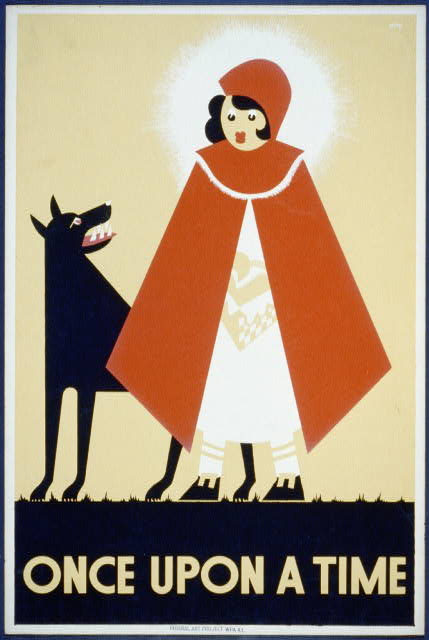
These three illustrations are from The By the People, For the People: Posters from the WPA, 1936-1943 collection at the Library of Congress.  Here's more about the project:

The By the People, For the People: Posters from the WPA, 1936-1943 collection consists of 908 boldly colored and graphically diverse original posters produced from 1936 to 1943 as part of Franklin Delano Roosevelt's New Deal. Of the 2,000 WPA posters known to exist, the Library of Congress's collection of more than 900 is the largest. These striking silkscreen, lithograph, and woodcut posters were designed to publicize health and safety programs; cultural programs including art exhibitions, theatrical, and musical performances; travel and tourism; educational programs; and community activities in seventeen states and the District of Columbia. The posters were made possible by one of the first U.S. Government programs to support the arts and were added to the Library's holdings in the 1940s.


All of the illustrations are very evocative of their time period.  I really love the simple graphic design of the Little Red Riding Hood.  I've been seeing it appear around the internet and had to learn more about it.  Then I found these other two along the way.   

Saturday, December 12, 2009

Little Match Girl Week: Up and Coming Illustrators

To finish the week, here are some Little Match Girl illustrations by illustrators featured on Picture Book:

First, here's a series of five by Aya Tsai which are quite lovely.


And finally a single illustration by Lucinda McQueen with a happier tone even if the match girl is painfully young in this one:


Friday, December 11, 2009

Little Match Girl Week: Classic Illustrations

Today I offer some different illustrative interpretations of Little Match Girl by Golden Age illustrators, courtesy of my own website:


by Arthur Rackham


by Harry Clarke (I have a love/hate relationship with Clarke's illustrations and this is one of the ones that simply doesn't work for me.)


by Anne Anderson


by Honor Appleton

Thursday, December 10, 2009

Little Match Girl Week: More Picture Books

Here are some more Little Match Girl picture books. I am sharing reviews culled from several sources. Both Amazon and Barnes and Noble have reviews for different versions under the same title--in other words, reviews for one version listed under ones illustrated by someone else. The clues in the review help, but I have sorted the reviews with their proper editions below.

The first is still in print:


From School Library Journal (this review also includes Lavrey's Little Red Riding Hood:

Gr 1–3—The first retelling is true to the original poignant tale of hunger, cold, and the death of the young girl selling matches on the street. Lavreys's fanciful acrylic paintings soften Andersen's indictment of an indifferent society that allows such poverty and misery to exist. The resignation and calm on the girl's face capture her sadness, as does the artist's palette of soft colors. Bright colors, collage elements, and whimsical landscapes suit Little Red Riding Hood. The girl's coat is a collage of faint words, and she follows a path strewn with vowels through the sun-lit woods. A sinister wolf is coiled around a slanting tree and distracts the child long enough for him to arrive first at Grandma's cottage. This springtime version makes an interesting contrast to Jerry Pinkney's Little Red Riding Hood (Little, Brown, 2007), which takes place in winter. Lavreys's fanciful folk art expands the way young readers and listeners will see this familiar tale.—Mary Jean Smith, Southside Elementary School, Lebanon, TN

Lavreys is busily illutsrating more fairy tales, too, with her recent Snow White, Sleeping Beauty, and forthcoming Cinderella.

This is another one of my favorite versions of the tale in picture book format and was referenced in the review for Lavreys's version above. It's still available in paperback but only used in hardcover. Here is Jerry Pinkney's Little Match Girl.

Jerry Pinkney is a much honored children's book illustrated and has started a mini-dynasty as the father of Brian Pinkney, another great illustrator.


From Kirkus Reviews:

Pinkney's deeply moving treatment of Andersen's classic tale moves the events to an urban America of the 1920s. On a freezing New Year's Eve, a girl stumbles outside in her stocking feet to try and sell matches. The jovial holiday crowd hustles by her; she is afraid to go home, where her father will beat her. To keep herself warm she lights her matches, and each blazes in a dream of holiday happiness. Her last vision is that of her kind grandmother, whom the child joins in a place beyond the reach of cold and poverty. On the last page, two shooting stars are shown blazing across the dark New Year's sky. Pinkney's detailed watercolors bring to life this cold winter night, and profusion of food and gifts just out of the girl's reach. Flecks of snow tumble across the outdoor scenes, and warm yellow candlelight make indoor settings look especially cozy. Pinkney's sense of pacing is also just right; readers will be captivated by the intimacy and drama his illustrations create. The result is so affecting that some will believe they're encountering this story for the very first time.

This final book is out of print and definitely one of the most avant garde of any fairy tale picture book retelling with its innovative illustrations by Kveta Pacovska with text retold by Anthea Bell (a prolific author of fairy tale picture books):


Publishers Weekly Review:

Bell (The Little Mermaid) renders Andersen's story with painful vividness, resisting the urge to draw attention to her own prose. Instead Pacovsk 's stark expressionist plates dominate the pages. An eminence grise among European illustrators, she fully exploits the media in which she works. Collages overlaid with pastel and felt-tip pen, printed on heavy, glossy stock, represent elements of the Little Match Girl's story. Her life unfolds as bold red-scribbling, terrifying chaos. Her frozen feet are white lines on black, while smaller drawings experiment with other deceptively simple ways of drawing feet and matches. A little red "WHoosh!" taped into a narrow gap between blocky, steel-gray apartment buildings indicates where she sits; later, a shooting star foretells her death. The star falls across a full-bleed spread, its path on the left page stenciled into shiny silver foil, like a lake or a mirror; the right-hand page depicts a series of pastel smudges arranged in a grid that seem to stand for the tears and dirt on the Little Match Girl's face, but also resemble an artist's palette. With smaller fragments of silver, the star strikes the heroine. Every page contains a similar shock, a moment of alienation, and yet viewers will likely feel the rightness of these images for one of Andersen's most disturbing stories. This rendering will be best suited to those who know the tale well and can appreciate this intellectual, abstract presentation. All ages.

Review from School Library Journal:

Grade 1-4–An internationally renowned Czech artist brings her avant-garde perspective to Andersen's timeless fable. Pacovská's playful art is challenging and experimental, featuring childish scrawls, bright smudges of color along with silver inlays, and whimsically amorphous figures. One illustration depicts the girl's eyes, nose, and cupped hands scribbled across what appears to be a financial balance sheet. One spread consists of squares of color smudges facing a shiny silver page on which readers find their own reflection. The two pages are linked by a multicolored paintbrush/matchstick form. The image of the matchstick recurs throughout in all colors and shapes, singly or in groups, some leaning at angles, some resembling picket fences. Though the art challenges, it is appropriately childlike and whimsical, and opens this classic tale to new interpretations. Thoughtful students of folktale will welcome Pacovská's brilliantly innovative vision.–Marilyn Taniguchi, Beverly Hills Public Library, CA

Review from Booklist:

Gr. 2-4. This striking picture book, with its smooth, able translation, presents Andersen's story of the little girl who stands out in the bitter cold on New Year's Eve, hoping to sell matches. When no one buys them, she lights her matches and sees beautiful visions in their flames. The next morning, she is found dead. Many illustrators have presented idealized visions of the match girl, which tend to sentimentalize her story, but Pacovska takes a different approach. Winner of the Hans Christian Andersen Award for illustration in 1992, the artist doesn't depict the tale realistically or emphasize its pathos; instead, she offers expressive and sometimes expressionistic pictures. Even the placement of story and illustration is unusual. The entire text appears on five pages, interspersed among 12 full- and double-page illustrations. Featuring bold colors in mixed media, silver foil elements, and cut-paper collages, the striking artwork is naive in style but sophisticated in design. Often abstract and sometimes puzzling (a giant's body with a bird's head clutching a fork), Pacovska's highly original illustrations leave plenty of space for interpretation and imagination, especially for art students. Carolyn Phelan

Wednesday, December 9, 2009

Little Match Girl Week: Rachel Isadora (and some extras)


The Little Match Girl by Hans Christian Andersen and illustrated by Rachel Isadora is perhaps the most popular picture book version of the tale, staying in print since 1987 when it was first published.

Review from Publishers Weekly:

Andersen's tale about a little girl who's afraid to go home because she hasn't sold enough matches is a classic. The little girl, bareheaded and barefoot, curls up in a corner, lighting match after match to warm herself. In the flames she sees visions; in the final one, her grandmother appears and lifts the little girl into heaven. With muted blues, grays and browns, Isadora captures the mood of a snowy Victorian winter reminiscent of Dickens's A Christmas Carol. With these illustrations, coupled with superb book design, the artist has surpassed even the splendid art in her previous books.


The last few years, Isadora has published several fairy tale picture books with African settings and stylized illustrations, pictured below.


The Ugly Duckling


Hansel and Gretel


The Princess and the Pea


Rapunzel


The Twelve Dancing Princesses


The Fisherman and His Wife

Tuesday, December 8, 2009

Little Match Girl Week: Striking 12 by Groovelily


Striking 12 by Groovelily is a musical of Little Match Girl for lack of a simpler explanation.

Here's more from the Groovelily website:

Striking 12 is the concert-with-a-story, band-is-the-actors GrooveLily secular holiday show that put us on the map of the musical theatre world. We wrote it with Rachel Sheinkin, who is now famouser for having won a Tony for the book of The 25th Annual Putnam County Spelling Bee. But we had her first.

“Striking 12″ is indeed a holiday show that has more heart and fun than most of the manufactured entertainments competing for your consumer dollars.
– Frank Scheck, The New York Post

…this modest show is more artfully crafted and engaging than virtually all the standard-mold musicals coming our way these days…The most important ingredient for a successful musical, it has long been acknowledged, is a first-rate score, and this one is terrific. The lyrics are alive with wit and humor, and they don’t shy away from surging emotion either. I was hooked by a single, lovely pair of lines that manages the tricky feat of encompassing both: “I would not dwell on the past/If time would not go by so fast,” Mr. Milburn sings in “Last Day of the Year.” The music is rhythmic pop founded on a rich vein of melody, with Ms. Vigoda’s electric violin adding a distinctive note to the clean but potent arrangements.
– Charles Isherwood, The New York Times

Performances of the show are popular this time of year, but you can also buy or download the music at various sources, including Amazon.

Groovelily also has another fairy tale oriented show, Sleeping Beauty Wakes.

And in the music vein for this fairy tale, don't forget my entry on The Little Match Girl Passion by David Lang which won the 2008 Pulitzer Prize for Music.

Monday, December 7, 2009

Little Match Girl Week: Short Film by Roger Allers


This is an online video version of Disney/Pixar's Little Match Girl, a short. For a better quality version, you can find the short as an extra on The Little Mermaid (Two-Disc Platinum Edition) from Disney.


The music is by Alexander Borodin (String Quartet No. 2 in D Major: Third Movement: Notturno) and a lovely choice. I'm partial to Borodin myself because he's one of my husband's favorites. He loves the Polovtsian Dances.

Sunday, December 6, 2009

Little Match Girl Week: Matchless by Gregory Maguire


Matchless: A Christmas Story by Gregory Maguire came out earlier this year, although a version of it was first read by the author on NPR last year. You can still listen to the story (or read it) on the NPR site or read an transcript of the program here.

Every year, NPR asks a writer to compose an original story with a Christmas theme. This year, Gregory Maguire reinvents the Hans Christian Andersen classic "The Little Match Girl" for a new time and new audiences.

When it was first translated from Danish and published in England in the mid-19th century, audiences likely interpreted the Little Match Girl's dying visions of lights and a grandmother in heaven as metaphors of religious salvation. Maguire's new piece, entitled, "Matchless," re-illuminates Andersen's classic, using his storytelling magic to rekindle Andersen's original intentions, and to suggest transcendence, the permanence of spirit and the continuity that links the living and the dead.

An illustrated gift edition of "Matchless" will be published by William Morrow in fall 2009.

And so it was and is now available for purchase.

Maguire is familiar with fairy tale retellings, some traditional tales, but is most famous for his Wicked, retelling the witches's stories from Wizard of Oz.

I've been saving a post on Matchless for several weeks, debating whether or not to devote a week to the tale this December. After focusing on The Nutcracker last week, I decided to continue with another week devoted to Andersen's tale. It is bittersweet, but still a lovely story for this time of year and perhaps the fairy tale best associated with the holiday season.

I, of course, have the tale annotated on SurLaLune, but I will highlight books and other materials about the tale this week.

Thursday, December 3, 2009

Matchgirl Ballet


Next week is Little Match Girl week on SurLaLune, but since this is performed this Friday and Saturday by Columbus Dance Theatre, I am offering a preview:

From Ballet goes step beyond classic seasonal fairy tale by Bill Mayr:

The Little Match Girl centers on a poor girl sent out on the street by her harsh father to sell matches on New Year's Eve.

"She's very cold, so she starts to strike matches," Veach explained. "Each time she strikes a match, she has a vision -- a vision of a warm fire, a vision of a banquet where the food comes to life. She has a vision of her grandmother, who is dead, who takes her away to heaven."

The end of the story, Veach noted, is very sad: "People ignored her, and she dies in the cold. But her grandmother takes her away."

That ending, though, serves as the first act of Veach's ballet.

In the second act -- which "looks very different," he said -- the girl arrives in paradise.

"Costumes and scenery are time-nebulous because there is no time in paradise," he said. "All the people on earth who treated her badly dance for her. And she forgives them."

Tuesday, September 15, 2009

The Little Match Girl Passion by David Lang


Did you know that David Lang won the 2008 Pulitzer Prize for Music for his The Little Match Girl Passion? (Here's an iTunes link: Lang: the Little Match Girl Passion if you prefer to listen to samples there instead of Amazon.)

Co-commissioned by Carnegie Hall especially for Paul Hillier and Theatre of Voices, David Lang's The Little Match Girl Passion was awarded the 2008 Pulitzer Prize in Music. Setting Hans Christian Andersen's fable in the format of Bach's St. Matthew Passion, Lang elevates the suffering of the little match girl with poignant, evocative music. Lang's piece is scored for four voices and a few percussion instruments, played by the singers. They sing the sad story of a little girl who freezes to death selling matches on the street during a cold winter's night. In notes Lang wrote to accompany the Carnegie Hall premiere last October, he says he was drawn to Andersen's story because of how opposite aspects of the plot played off each other. 'The girl's bitter present is locked together with the sweetness of her past memories, ' Lang says. 'Her poverty is always suffused with her hopefulness. There's a kind of naive equilibrium between suffering and hope.'

Here are some links to reviews and articles about the composition for your further enlightenment:

David Lang Wins Music Pulitzer

David Lang - The Little Match Girl Passion

Carnegie Hall: The Little Match Girl Passion David Lang

Sounds Heard: David Lang's the little match girl passion

With the cold weather and holidays fast approaching, this sounds like a wonderful addition to a holiday music collection since this is one fairy tale that is very much associated with the winter season.