Tuesday, September 14, 2010

Of Mirrors, the Sun and Snow White


One of the most ubiquitious elements of Snow White and the Seven Dwarfs is the magic mirror.  Most of us know some version of "Mirror, Mirror on the wall, who's the fairest of them all?" It is such a popular part of the tale that it is hard to imagine Snow White's wicked stepmother without it. There has even been an entire novel devoted to the mirror, Mira, Mirror by Mette Ivie Harrison.

However, there are no mirrors in many Snow White variants.  In some, the older woman has no magic informer but relies on people, such as servants or visitors to her inn, to tell her she is the most beautiful.  This is common in several of the Innkeeper variants of the tale from southern Europe.  When the daughter grows older and the answer changes, the woman is jealous and orders her daughter's death. 

Perhaps the most common substitute for the mirror is a rather wonderfully logical object: the Sun. Many Snow White variants have the mother, stepmother, sisters, etc. asking the Sun who is the most beautiful. 

For example, in "Marietta and the Witch, Her Stepmother" from Greece, we read:

“My great and beautiful Sun! You who go around the world, tell me: Have you seen a woman more beautiful than me?”


“I am beautiful, you are beautiful,” replied the Sun, “but not as beautiful as Marietta.”

In most of these variants the implication is that the Sun is all-seeing and all-knowing thanks to its daily travels so it can best tell who is the most beautiful person in the world. The Sun never gives advice on how to destroy the beautiful daughter, it is quite simply logical and truthful in its answers.  Thus it betrays the Snow White character over and over again as she survives each murder attempt and even explains where she is living.
 
It's rather ingenious and even overcomes the questions over technology and availability of mirrors in past times.  Perhaps the real question is which came first, the mirror or the Sun?
 
And, once again, you can read many tales with the Sun replacing the mirror in Sleeping Beauties: Sleeping Beauty and Snow White Tales From Around the World.
 
Sleeping Beauties: Sleeping Beauty and Snow White Tales From Around the World

Monday, September 13, 2010

Here There Be Dragons in Snow White


Sleeping Beauties: Sleeping Beauty and Snow White Tales From Around the World


Dragons, dragons, DRAGONS! If you read enough around the web, you will see references to a Snow White variant in which her hosts are not dwarves--which actually they seldom are--but dragons.  Wikipedia is one such place, if it's not edited out.  (And, no, this is not the time or place to debate Wikipedia yet again!)  Moviemakers have apparently taken the term and run with it, for references to a Snow White film with dragons have also been appearing in many articles this year.

The truth of the matter is that, yes, in at least one Snow White variant the heroine--here named Marigo--ends up living in a castle with 40 drachen after escaping her stepmother and father.  The Albanian tale is "Schneewittchen" and can be found in Johann Georg von Hahn's Griechische und Albanesische Märchen.

The issue is the definition and translation of drachen.  Most German dictionaries only offer "dragon (as in mythical lizard)" or "kite (as in go fly one)" as the translation for "drachen."  However, there appears to be an almost archaic, less common reference to "heroic men" that doesn't appear in many dictionaries.  But overall, scholars translate the drachen in that tale as heroic men, not literal lizardy dragons as wonderful as that may be.

And, considering that in the majority of the Snow White tales from across Europe, the Snow White character ends up with either heroes (such as retired soldiers) or robbers as housemates and protectors, it only makes sense. 

But don't let this news disappoint you.  Whether there be lizardy dragons in the tale or not, it is one of the more interesting of the Snow White variants. 

For example, Marigo kills her mother through her teacher's instructions who then becomes her wicked stepmother.  This scenario doesn't appear in many Snow Whites although it is found in other tales.  Better yet, the father is not absent but complicit for he tries to kill his daughter as his new wife's demands although he is fortunately unable to carry through. At least at first, he tries the passive aggressive route to murder--abandoning her in the wilderness--which spares her life. 

Then when the stepmother learns that Marigo is still alive, she sends the father back time and again in disguises to kill his daughter.  So the father is the co-villain for he fails to stand up for and protect his own daughter who is herself not quite innocent having killed her own mother.  (As I've said before, you just can't beat a fairy tale for amazing storylines.)  This tale also ends with Snow White being revived and married to her prince charming, but her parents are not punished for their crimes.  They are simply not mentioned after her revival.  The ending is rather abrupt actually, but fascinating for that very reason.

Yes, it is a very interesting variant of the tale, a great horror movie plot for the taking.

(This one is going on my short list of tales I'd love to hand to people who get that condescending tone when they learn I work with and study fairy tales.  "Oh, how sweet!"  Sure, if matricide and other forms of murder are "sweet."  This isn't one you'll be reading to your child at bedtime anytime soon, I'm sure.)

Due to it's increasing notoriety and fascinating content, I translated the tale from the German and it is included in Sleeping Beauties: Sleeping Beauty and Snow White Tales From Around the World. as "29. Snow White from Albania."  And I kept the term "dragons" in my translation.  It is such a wonderful word that I hated to change it to another less romantic term...

Sunday, September 12, 2010

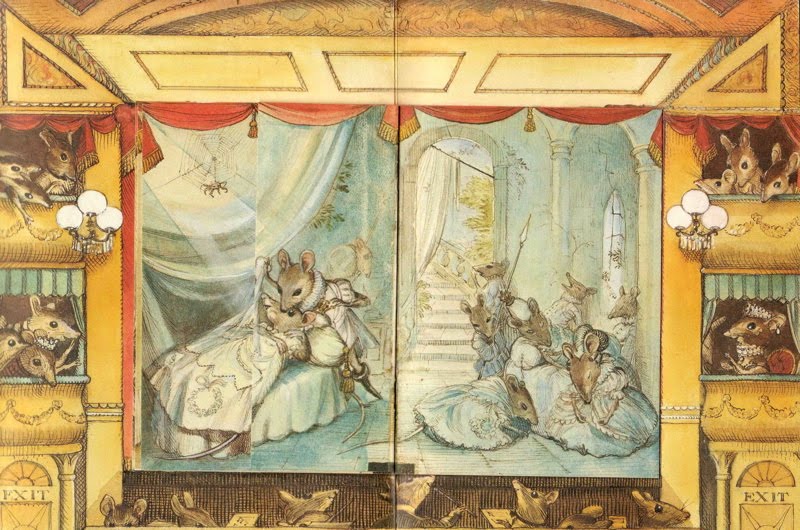
John S. Goodall's Theatre The Sleeping Beauty


My own collecting of fairy tale illustrations has lessened over the years as other websites have stepped into the excellent job of sharing more illustrations than I can produce myself.  My focus, as always, has been primarily on the texts, but that doesn't mean I also don't love the illustrations.  Today I am sharing pictures from one of my favorite illustration blogs, Vintage Kids' Books My Kid Loves.  Almost a year ago, she shared her scans of John S. Goodall's Theatre The Sleeping Beauty (Atheneum, 1980).

These are the types of illustrations that are better large so you can see the details, so do click through to see them.  You can read more about the book on the other blog's page linked above, too.


Tomorrow I will start a full week of Snow White and Sleeping Beauty discussions.  Some of them are already written and in the queue so stay tuned!

Saturday, September 11, 2010

More About Upcoming Fairy Tale Films

This article is a reminder that I really, really, really need to start a master list of upcoming fairy tale themed film releases. There are too many to count at the moment...

From Hansel and Gretel Grew Up to Be Witch Hunters -- What About These Other Fairy Tale Characters? by Gary Susman:

'Hansel and Gretel: Witch Hunters' -- a real upcoming movie -- is a fairy-tale sequel gone gonzo, in which the now-adult siblings, having survived the gingerbread house incident, become bounty hunters in search of broom-riding, child-chomping sorceresses. It'll be the English-language debut of Norwegian pulp director Tommy Wirkola. And, according to Twitchfilm and Norwegian site Kultur, it's going to star Jeremy Renner and Noomi Rapace as Hansel and Gretel. (Renner reportedly revealed the casting in an interview he gave this week at the Venice Film Festival.)

What sounds terrific is not just the casting of 'The Hurt Locker's' adrenaline-junkie bomb defuser and 'The Girl With The Dragon Tattoo's' vindictive punk angel as Grimm avengers. It's also the notion of finding out what happens to fairy tale characters once they grow up, after the happily ever after. Yes, yes, Stephen Sondheim and James Lapine got there first with the Broadway musical 'Into the Woods,' but we haven't seen our childhood favorites adapted into genre movies.

That's already changing. On cable, SyFy has been developing TV movies, starting with last winter's 'Beauty and the Beast,' updating the classic tales, including a vengeance-minded 'Hansel and Gretel' that sounds like Winkola's project, and a 'Little Red Riding Hood' that finds Red fighting werewolves. Which, in turn, sounds similar to a Warner Bros. movie due in theaters next spring, a 'Red Riding Hood' directed by 'Twilight's' Catherine Hardwicke and starring Amanda Seyfried as a werewolf-beset Red.

Jack Frost and MST3K


Mystery Science Theater 3000, Vol. XVIII (Lost Continent / Crash of the Moons / The Beast of Yucca Flats / Jack Frost)

This is an odd one for today, but I debated it all week and finally decided it's a fun Saturday entry.  Mystery Science Theater 3000, Vol. XVIII (Lost Continent / Crash of the Moons / The Beast of Yucca Flats / Jack Frost) was released to DVD this week and the reason why I am highlighting it here is for Jack Frost, of course. 

Jack Frost is one of the many fairy tale film cult classics from Eastern Europe.  (See the list of these on SurLaLune.)  The film is also know as Father Frost and Morozko.  These films are beloved favorites for many people who grew up seeing them.  They are not nearly silly enough to be considered great fodder for MST3K treatment, but the English dubbing has often made them better candidates.


I haven't watched much MST3K in recent years, but it used to be a regular Friday night activity with my brother back in the days when I still lived at home with my parents--a long time ago!  I still remember my first exposure--the movie Daddy-O--and after I adjusted to the entire premise, I laughed a lot.  I still do.  And now I am feeling a little nostalgic for Tom Servo...

You can read more about this particular collection at Criterion Cast.

And here is a trailer for Father Frost, not the MST3K version, just the film itself which you can still buy used although it is out of print.

The last film of the set is one Jack Frost, which they did during the Sci-Fi Channel years. They got them to bend the rules every so often, to stray from the usual sci-fi fare and to do something more out of the ordinary. And what’s more out of the ordinary than a Russian fairy tale film in beautiful color? We have a hero turn into a bear, an evil stepmother, a witch in a house with legs and a mushroom man. And I’m not making any of that up. It’s actually one of the better films they’ve ever covered, but because of the horrid dubbing within, it makes for great banter for the crew. They somehow take one of the crazier films and turn up the goofy factor to 11 and we all win because of it.


Father Frost / Morozko


Gold Box Deal: Shelley Duvall's Faerie Tale Theatre: The Complete Collection


Shelley Duvall's Faerie Tale Theatre: The Complete Collection

One of Amazon's Gold Box deals for today is for Shelley Duvall's Faerie Tale Theatre: The Complete Collection. Recently it's been $29.99 but today if you go to the Gold Box deals, it is $23.99.  You will only see the price on the Gold Box page, not the regular product page. 

As with all Gold Box offers, this will only be good while supplies last or until midnight pacific time, whichever comes first.

Friday, September 10, 2010

Updates to SurLaLune


Sleeping Beauties: Sleeping Beauty and Snow White Tales From Around the World


I just wanted to drop a note to say that I am busily finishing up Twelve Dancing Princesses Tales From Around the World.  Another book, The Grateful Dead Tales, will be following very closely behind.  More about the how and why for that book later.  And then in my copious free time (ha!) I've been updating the SurLaLune site proper although I am always woefully behind on that to do list. 

So far, most of my updates are to the Similar Tales from around the World pages for Sleeping Beauty, Snow White, Frog Prince and Rapunzel.  I wanted to update lists and share with the new users discovering the site this academic year.  I'm still missing some of the updates to those lists, but they are longer and more comprehensive than ever before. 

I have finally mapped out many of the posts for a week about Sleeping Beauty and Snow White, discussing things I learned while working on Sleeping Beauties: Sleeping Beauty and Snow White Tales From Around the World

It's really difficult to be working on one book and thinking about promoting a previous one that is history in my head, especially when the next one is almost complete and I am busily making sure it is truly done.  I'm just thrilled with how many Twelve Dancing variants I've gathered for the collection, considering this is a much less popular tale in the scheme of things.  I have translated a few of the tales but I've also received permission to reprint a few harder to find ones that are under active copyright.  They are fun tales, too.  Such as the Hungarian version in which three princesses wear out three hundred pairs of slippers each night by dancing on razors.  Yep, once again, you just can't make this stuff up because someone already did it for you decades, if not centuries ago...

Then there is the regular fairy tale news and such, too.  I have some of that which I will try to share over the weekend. 

Wednesday, September 8, 2010

Beauty and the Beast Pillowcases


Okay, so I saw these in an email I received and had a small giggle.  Nothing fancy, but fun for those who read this blog, I thought.  They are currently on clearance with Acorn Catalog at this link.  And, no, I have no affiliation with Acorn, I'm just sharing because I was amused and thought you might be, too.  And really, I think of how the pillowcases could be interchangeable in my marriage, depending on our moods.  :)

Tuesday, September 7, 2010

Transformations: How Fairy Tales Cast Their Spell


Well, the holiday weekend is over here in the states and almost all of academia is headed back to the classroom by now.  (Yes, I know a few lingering term systems have a few more weeks left.)  To get us all in the mindset of a new wave of teaching and learning, I wanted to share a link to Transformations: How Fairy Tales Cast Their Spell.  You can choose to listen to an audio version, watch a video or simply read a transcript of the event  that took place in 2007.  No, this is not new, but I haven't linked to it before so it may be new to some of you.

Here's more information about it:
Transformations: How Fairy Tales Cast Their Spell
Roundtable
Participants: Anne Cattaneo, Mark Lamos, Donna Jo Napoli, Roger Rahtz, Maria Tatar, Jack Zipes (moderator)

In a recent article in Time, entitled "The End of Fairy Tales?" James Poniewozik refers to Shrek and other recent fairy-tale films and writes, "This is a new world of fairy tales: parodied, ironized, meta-fictionalized, politically adjusted and pop-culture saturated. . . . What these stories are reacting against is not so much fairy tales in general as the specific, saccharine Disney kind, which sanitized the far darker originals." This may, indeed, be true, as a reaction to Disney, but the new forms are really not new. Fairy tales have been transformed in diverse ways and have been transforming themselves ever since they originated in an oral tradition. What is fascinating about the fairy tale genre is precisely its transformative quality and capacity to capture our imaginations. However, it is not clear why we are so addicted to fairy tales and why we continually return to them, change them, and use them in such innovative ways in the theater, opera, cinema, school, at home and, of course, on the Internet. Fairy tales touch our lives from birth to death. As a genre they were never developed or cultivated for children until late in their development, and adults are largely the writers and creators of fairy tales in practically every country in the world. The tales continue to speak to us and call out, it seems, for transformation. This panel will set out to discover the sources of this tradition and how it infuses and is infused by imaginative processes, including indigenous myth, religion, art, dream-life and morality.
The discussion begins with a discussion of "The Story of the Fairy Tale" by Carl Ewald which you can read on SurLaLune

And there are so many other fairy tales and works discussed from Shakespeare to Napoli's The Magic Circle and more.  (Which, really, if you haven't read The Magic Circle yet, you really, really should.  It's a short masterpiece.)

And, finally, if you're still debating whether or not to follow the link, here's an excerpt:

Napoli: I’ve been thinking about this, and I think the difference between a myth and a fairy tale and a religious story is just what kind of term we want to call it. Because I can think of myths and religious stories and fairy tales that deal with a whole range of things, all of them, and I think we call it a myth when we know that it used to be somebody’s religion and we don’t believe anybody is believing that today, or we think it would be absurd if they believed it. I think we’d call it a religion if we are trying to show at least lip service to some deference for what they might believe. And I think we call it a fairy tale if there aren’t gods in it. But they’re all the same kind of stories, I think.


Zipes: Yeah, I tend to agree. I think that most of these stories come out of very basic experiences that we’ve had in nature, in our environment, and depending on the modality in which we want to convey our experience, we tell it in one metaphorical way using certain conventions, and these conventions and motifs and narrative structures and plots have changed and developed over thousands of years, so that even when we tell fairy tales, we use other media, like film and the radio, now the Internet, and of course plays and musicals and operas. I think that why we choose or continue to come back to certain canonical tales is that they are unresolved. Even though they are resolved, they’re still unresolved.

For instance, I’ve written on Cinderella recently in which I’ve tried to understand—I’ve always looked to a sort of feminist critique talking about the passivity of Cinderella, but really what the story is about is what happens to a child when a mother dies and a non-biological mother comes and maltreats a daughter that’s not of her own making, and favors her own children. Now that’s very common today, with broken families and single parents or new parents, or sometimes there are third marriages and so on. If you do a study of recent children’s books, plays, and so on, Cinderella is probably the most popular tale in the world right now in terms of redoing it, reexamining it, exploring it. So these are deep-rooted problems that come out of our drives, our instincts, that we store in our memories and work through and keep trying to work through. Because a particular tale is so artistically well done, at a certain point it becomes sort of the focal point that we continue to pass on and disseminate and revisit to try to continue to deal with these problems. As long as the problems remain, we will continue to tell the same tales, I think.

Friday, September 3, 2010

Swedish Fairy Tales and John Bauer


I will be returning to more Snow White and Sleeping Beauty posts next week.  I have so much I want to write, but it requires sitting and thinking which isn't happening very easily this week.  So after the holiday weekend in which I hope to get caught up in other areas of my life, I hope the blog will become more of a conversation again, welcoming in the new collegiate school year.


Anyway, I have been reading many, many fairy tale collections for the SurLaLune book series and am working my way through some Swedish tales, too.  Admittedly, if one is going to own a collection of Swedish fairy tales, it should undoubtedly be one illustrated by John Bauer, such as Swedish Folk Tales or Swedish Fairy Tales.

Swedish Folk Tales Swedish Fairy Tales

It's all too easy for me to neglect Swedish fairy tales at times since not many of the tales fit into the popular tale types I work with the most often.  However, paging through one of the collections illustrated by Bauer is enticing, making one want to KNOW what these tales are about.  And, really, I need to do better for I have quite a bit of Swedish heritage--at least an eighth--that I have neglected over the years.  The German and Norwegian parts of me are so much easier to explore folklore-wise.  (But I have a full quarter German and a full quarter Norwegian parts with living relatives who remember the heritage better, too.  My Swedish great-grandfather died very young of TB, leaving behind a young wife and two small daughters, one of whom was my maternal grandmother.)


Bauer makes the trolls quite lovely in their uniquely ugly way. 


Then one looks at an illustration like this one and thinks, AHA! A Swedish Snow White!  Nope, not at all.  The girl is giving away the fruit to poor passers-by actually.  How easy it is to assume and be wrong.

All of these images are from Artsy Craftsy by the way, part of Art Passions, which has been around for about as long as SurLaLune.  All of the images are available as art prints.  Lovely, lovely.  You can also read more about John Bauer on Wikipedia.  His work has such a modern touch to it that it is hard to fathom he died in 1918.

Wednesday, September 1, 2010

On the Side: Third edition of OED unlikely to appear in print format

Kindle Wireless Reading Device, Wi-Fi, 6" Display, Graphite - Latest Generation


This made the rounds yesterday but in case you missed it, from The Guardian: Third edition of OED unlikely to appear in print format:
Publishers of the Oxford English Dictionary have confirmed that the third edition may never appear in print. A team of 80 lexicographers began working on it following the publication of the second edition in 1989. It is 28% finished. In comments to a Sunday newspaper, Nigel Portwood, chief executive of Oxford University Press, which owns the dictionary, said: "The print dictionary market is just disappearing. It is falling away by tens of percent a year." Asked if he thought the third edition would appear in printed format, he said: "I don't think so." However, an OUP spokeswoman said no decision had been made.

"It is likely to be more than a decade before the full edition is published and a decision on format will be taken at that point," she said.

The Oxford English Dictionary already publishes revised and new entries online every three months, with a new version of its OED Online website due to be launched in December.
I would miss not having a permanent record of something on paper, but I hardly ever use a paperbound dictionary myself and have debated for the last few years if I even need to devote the shelf space to my reference books, practically blasphemous for a trained librarian and book lover.  However, I find I am using dictionaries more than ever before as I work and translate, just not in print.  So my usage is up and made even more convenient thanks to electronic resources. 

However, another recent article making the rounds, too, is Why E-readers Are Good for Books: People Read More by Mathew Ingram:

A recent survey found that 40 percent of those with e-readers said they were reading more books than they used to before they had the device, which is consistent with earlier data on e-reading habits. E-book sales climbed by more than 200 percent in the first six months of this year, according to the Association of American Publishers.

The survey by Marketing and Research Resources found that 58 percent of those with e-readers (including the Apple iPad, the Amazon Kindle and the Sony Reader) said they read about the same number of books as they did before, while 2 percent said they read fewer books. More than half of those surveyed said that they expected to use the device to read even more books in the future. While the survey was funded by Sony, other research has found a similar increase in book reading by e-reader owners. A study earlier this year by L.E.K. Consulting also found that almost half of those with e-readers were buying and reading more books, and Amazon has said that customers buy more than 3 times as many books after they buy a Kindle e-reader.

Interestingly enough, the L.E.K. survey found that 36 percent of the books read by people with e-readers were what it called “incremental consumption.” In other words, e-reader owners were reading new books, rather than books that the owner would otherwise have read in print. The global consulting group reported the findings in its second annual “Hidden Opportunities in New Media Survey” of more than 2,000 households. According to recent figures from Amazon, in the second quarter of this year the company sold 143 Kindle e-books for every 100 hardcover books sold.

And my stats are entirely the same--I am reading more with my Kindle than I ever did before and that didn't even seem to be humanly possible. I have books more accessible to me in more places for one thing. I don't worry about buying a book and where I will have to store it or give it away. I also can impulse buy faster and easier than ever before. And I do. Oh, I definitely do. I currently have over 1,500 ebook titles stored on my computer and/or Kindle. Yes, many were free, but I have paid for a goodly percentage, too. The older titles replaced books that were crumbling on my shelves which have gone on to other homes. I'm also choosier about my keeper books since I know many titles will be available to me electronically if I ever want them again.

Also, I tend to choose one of my ebooks to read before a paper copy so I have paper editions languishing on my shelves awaiting handling from me.

So reading isn't going away even if the format is changing.

And no one is more shocked at my own changes and approaches to reading than me.  Really.  The Kindle is perhaps the biggest life changer for me since I first accessed the internet sixteen or so years ago.

Interesting times, these are!

The International Children's Library


The International Children's Library is a fairly new online book initiative that I learned about recently.  I haven't had too much time to explore it yet, but of course my first search was for "fairy tale."  Did anyone ever doubt that it would be?

Good news is that there are some great hits in the 232 search results, some of which are in other languages and not as readily accessible in various countries.

It looks the most like Google Books and Archive.org when it comes to the actual page images--they are actual scans of the pages. And some of the books are under copyright and thus not available anywhere else, but apparently are provided here with permission from what I can see.

For example, see this Schneewittchen from Germany:


However, the navigation is not as intuitive as I like and there are not easy sorting options beyond language choices once you've performed a simple search.

Still, for fun browsing and exploring, it's another resource to add to the list.  I hope to see it grow in the years to come...