Showing posts with label children. Show all posts

Thursday, November 19, 2015

Fairy Tale Gift Shop Discoveries at the Museu Nacional d'Art de Catalunya


As I mentioned last week, I was blessed to go on vacation in October--mine and John's first vacation in four years, almost to the day. We were LONG overdue. Our vacation was long and eventful and occasionally I saw fairy tale things.

One of the best sightings was on our first day of the trip when we were in Barcelona at the Museu Nacional d'Art de Catalunya. The gift shop had lots of fun things in it. I was so tired and jetlagged at that point that I also didn't care about taking pictures and the gift shop staff didn't say me nay either. So here are my photos for my own reference and where I found them later online for more information and better pictures.

It was an amazing museum, too, by the way. I really was exhausted and John ended up sleeping on a couch for a bit because his body just shuts down on him. He wasn't bored, just couldn't keep his eyes open anymore.


These Build Your Own Bobble Head - Fairy Tales were something new to me and looked like fun. If I was still working in a library, I would have snatched these up and assembled them for a display in the children's room. I had a few fun displays back in my day.


This Prince Philippe with the frog prince is by Djeco Toys--apparently made by France's Papo which I see has many fairy tale themed items--some I've investigated before. I will research and share more in a separate post soon! The Djeco site has that animated stuff you are forced to load and watch before you can really see much which is followed up by mystery meat navigation which I don't have time to mess with today. Or any day for that matter. Sells and informs absolutely nothing to anyone. 


These Shrinkables - Fairy Tale were perhaps the most tempting but on the first day of a trip, I was very reluctant to add ANYTHING to my luggage. Fortunately, I found these online and now have them in my wishlist for a possible splurge someday in the future. These reminded me of the Shrinky Dinks I loved when I was in 4th grade, many moons ago.
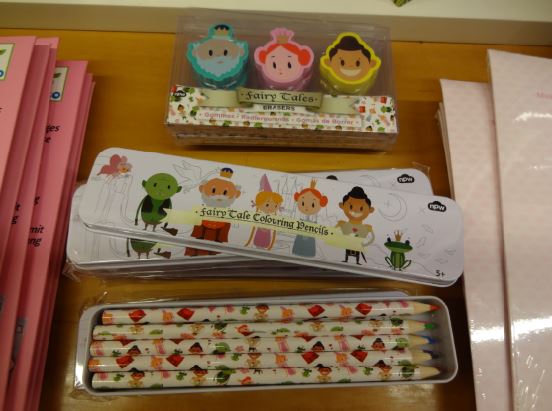


Again, I am a school supplies and stationary junkie, so I wanted these Fairy Tale Color Pencils and the erasers pictured above them, too. But I practiced self control yet again!


Finally, there were a few pieces from the UK's Tyrrell Katz brand. With further research, I've learned these are part of the Princess line and include many items, such as the backpack at the top of this post and more. The museum didn't have the Tyrrell Katz Princess Beaker, which is a good thing because I bet I would have bought that to hold pencils on my desk. Which may have convinced me to buy the Fairy Tale Color Pencils and then the self mastery would have been sliding down that slippery slope of indulgence. I ended up with room in my luggage by the end of the trip, but I didn't know that at the beginning! And since international delivery is very cost prohibitive for a beaker, I think this will remain as an image in my files instead of a pencil holder on my desk! 

Friday, May 15, 2015

Fairy Tales in Advertising: Prefeitura de Jaraguá do Sul: Once upon a time


Prefeitura de Jaraguá do Sul: Once upon a time
Don't let sexual violence against children repeat.

This is an ad for the Brazil's national day against violence, abuse and sexual exploitation of children on May 18, 2013. This Monday will be May 18th again. I thought I about saving the post for that day instead but I actually like to know about these days in advance so here is the ad as a reminder on our usual Friday instead. A very important cause and a fine poster to call attention to it.

Campaign info from Ads of the World:

Advertising Agency: Squeeze, Florianópolis, Brazil
Creative Director: Cristiano Valente
Art Director: Cristiano Valente
Copywriter: Luisa Sganzerla
Published: May 2013

Tuesday, July 15, 2014

Children, Fairy Tales, and Richard Dawkins


So last month, Richard Dawkins, world-famous evolutionary biologist and atheist, started a brouhaha when he essentially said fairy tales are harmful to children. See the article at Richard Dawkins on fairy tales: 'I think it's rather pernicious to inculcate into a child a view of the world which includes supernaturalism'. He has since backtracked a little--he was musing, not demanding--when even his faithful adherents balked at his statement. But the media hasn't let up and lots of articles are a result.

Dawkins admitted that he had once questioned whether a "diet of supernatural magic spells might possibly have a detrimental effect on a child's critical thinking."

But he added: "I genuinely don't know the answer to that, and what I repeated at Cheltenham is that I think it is a very interesting question. I actually think there might be a positive benefit in fairy tales for a child's critical thinking ... Do frogs turn into princes? No they don't. But an ordinary fiction story could well be true ... So a child can learn from fairy stories how to judge plausibility."

He added: "Fairy stories might equip the child to reject supernaturalism when the time comes … Santa Claus again could be a very valuable lesson because the child will learn that there are some things you are told that are not true. Now isn't that a valuable lesson? Unfortunately it doesn't seem to have had the desired effect in some cases, because after children learn that there is no Santa Claus, mysteriously they go on believing that there is a God."

I obviously don't believe fairy tales are harmful to children. I also believe in knowing your child and deciding what they can or cannot handle. But I really don't have the inclination to enter into this particular fray with a longer discussion. My life's work is about this.

But what I would find interesting would be a study that compared the early life experiences of children who felt betrayed when they learned the "truth" about Santa Claus and the Tooth Fairy and such versus those who were sad perhaps, but moved on quite easily, rather taking it as a step into adulthood, being let in on the secret, per se.

The latter reaction, or reporting of it, has been my more common experience when I've discussed this over the years with various people. The only person I can personally think of who was perhaps devastated was my own grandfather--one of his few happy childhood memories was staying up all night in the hayloft watching for Santa before falling asleep and missing him. He never admitted to devastation upon learning about Santa but there was a hint of it in the story which he told for humor, the loss of a happy outlet in what was a rough childhood, a childhood for which we received virtually no stories beyond playing sports and some farm chores. He did end up an atheist and occasional agnostic depending on the day. No scientific study and just anecdotal stories, but I have personally seen correlations to how the "truth" was discovered--and how fervently it was espoused by the adults prior to the "enlightenment"--to have a greater impact than the stories themselves.


Since SurLaLune is devoted to education about fairy tales, many of these articles and interviews will be helpful to those who are reading and writing about children and fairy tales. So I thought I would gather a few articles here.

Here we go:

Richard Dawkins is wrong to dismiss the power of fairytales by Marina Warner. Warner is another person who has devoted her life to fairy tale studies among other things. Her book, From the Beast to the Blonde: On Fairy Tales and Their Tellers, is must-read reading for anyone devoted to fairy tale studies.

When Dawkins remarks that besides science, everything else is "a second-rate explanation of existence", he can't really mean what this implies: that imaginative culture, however speculative and unverifiable, has little illuminating effect. You can criticise fairytales for a lack of ethics (does Aladdin deserve his fortune?). You can criticise this version or that for vile ideology (antisemitism in Grimm; female beauty as the ultimate good; rank consumerism; delight in cruelty). You can deplore the wishful thinking as peddling illusions. But literature and story-telling are in the paradoxical business of making things up to make us feel a little better, even as they confront the worst.

Dawkins's attack on fairytales has been reported unfairly – he was musing rather than laying down the law. But you can't attack the wonder tale for reinforcing belief in God! On the contrary, the agents of fairytale enchantments – Puck, genie, fairy godmother – act outside any existing scheme of moral or religious salvation. Besides, magic has its own history and belief its seasons, and children today are very canny – they know the difference between believing in earnest and believing in play. The crowd queuing at King's Cross to push the luggage cart through the wall to Platform 9¾ and board the train to Hogwarts don't believe it's there; but they revel in the pleasure of let's pretend.

Writer Lauren Child discusses Richard Dawkins' claims that fairy tales can be harmful to children at BBC Radio 4 Today

I don't think they are anything to do with supernaturalism – I'm sure he [Dawkins] must know that. It's about a way of working things out. Children are always using the imaginary to work things out. Fairy stories are not so much about the magic, they are about figuring out the world.

Richard Dawkins should know it pays to believe in fairy tales by Jenny McCartney

Yet while critical thinking is very important – operating in the questing mind – I can’t help thinking that fairy tales do something just as essential to a child’s development: they encourage intuition, which is experienced in the gut.

There is something fundamentally captivating about the best-known fairy tales, as if their stories of menace and survival are hard-wired to human instinct. That is why they are so often a playground for psychoanalysts. Their landscape is mined with treachery masquerading as innocence: devouring wolves dress up as grandmothers, and friendly old ladies proffer poisoned apples. Children are pushed into positions of extreme self-sufficiency, surviving on luck and wits. The tales derive from an era when childhood in the West was stalked at closer quarters by poverty and abandonment.

Fairy tales carry just as much cruelty and psychological complication as reassurance – which is why authors and film-makers keep discovering fresh ways to retell them, from Snow White and the Huntsman to the most recent Maleficent, which beckons in Angelina Jolie to reinterpret the vindictive fairy in Sleeping Beauty.

Richard Dawkins: Fairy Tales, Father Christmas May Harm Children; Prompts Angelina Jolie to Respond by ANUGRAH KUMAR

Oscar-winner Angelina Jolie responded to British atheist professor Richard Dawkins' comments that fairy tales and belief in Father Christmas may harm a child's development, saying "a little magic" helps impart important moral lessons.

"There are morals in these stories and you want a little magic – it's important to have something that we're a little bit in awe of," Jolie, 39, told the Psychologies magazine. "Kids grow up fast enough these days, so let's allow them to have a little bit of childhood for as long as they can."

Jolie, who is raising her six children, was responding to the 73-year-old evolutionary biologist's talk at the Cheltenham Science Festival earlier this week where he said it is "rather pernicious to instill in a child the view that the world is shaped by supernaturalism."

"The other day, one of the kids lost a tooth and I talked about the tooth fairy," Jolie continued. "Half of them are old enough to think: 'What are you talking about,' yet they're still not sure there isn't something. And I'm not lying to them. I say, 'I really can't tell you. I don't really know. Mothers are sworn to secrecy.'"

Why we need fairy tales by MANDY HAGER

Yet as a scientist he must know that the reverse is true. It is through allowing the mind to wander into thoughts and worlds not yet colonised by others' theories or expectations that we have made the most spectacular leaps forward in knowledge and understanding. In fact, imagination and speculation have always been scientists' friends. Archimedes, Kepler, Galileo, Newton, Darwin, Curie, Lovelace, Carson . . . all the brilliant thinkers who have given the world so much started with a thought that must have sounded something like "What if . . .?"

Discovery and invention are merely the imagination made real after fancy takes flight. In fact, Einstein said "If you want your children to be intelligent, read them fairy tales. If you want them to be more intelligent, read them more fairy tales."

Thursday, June 26, 2014

New Book: Never-ending Stories: Adaptation, Canonisation and Ideology in Children's Literature


Never-ending Stories: Adaptation, Canonisation and Ideology in Children's Literature (Ginkgo Series) by Sylvie Geerts (Editor), Sara Van den Bossche (Editor) is officially released in July, but it is already shipping from book retailers.

I can't find much about this book online--but the description is intriguing. I also found the original call for papers for the symposium that apparently inspired this publication. So this is a collection of papers edited by the symposium organizers. I would love to see a full table of contents and will share one if I find one!

Book description:

The roots of children’s literature are commonly known to lie in adaptation. The texts most frequently adapted for a child audience are either canonised literary works for adults or children’s books which have acquired a high status of their own. In both cases, the stories are adapted to fit the needs of new readers in other contexts. This volume frames adaptation in children’s literature against a broader socio-cultural background, focussing on the ideological implications of the process. Emphasising both diversity and evolution, it deals with oppositional forces and recent trends informing adaptation. At its core are issues of transmediality and new reader roles, adaptations' orientation towards the ideology associated with the pre-text, as well as canonisation of the pre-texts and of the adaptations themselves. The volume is characterised by a broad international and diachronic spread, with topics ranging from traditional Western fairy tale adaptations to retellings of South African oral stories and Persian myths. The evolution discernible in the cases presented neatly illustrates how the process of adaptation allows canonical texts to develop into never-ending stories.

SYLVIE GEERTS and SARA VAN DEN BOSSCHE are researchers in the Department of Literary Studies at Ghent University.

I found this listing for one fairy tale related article in the book, so I know there are some articles within that will interest SurLaLune readers:

Title: How immortal is Disney's Little Mermaid?

Other Titles: The Disneyfication of Andersen's 'The Little Mermaid'

Authors: Van Coillie, Jan

Issue Date: 2014

Publisher: Academia Press

Host Document: Never-ending Stories - Adaptation, Canonisation and Ideology in Children's Literature pages:127-142

Abstract: Focusing on Disney’s adaptation of Andersen’s fairytale The Little Mermaid, this study reveals some essential characteristics of the so-called ‘Disneyfication’. In order to do so, a comparative analysis is carried out, based on concepts from narratology. The analysis focuses on changes in the plot, characters, space, time and perspective. The central question is in how far these changes are due to the inevitable differences caused by the transfer from text to screen or to the interpretation of Disney as it is reflected in the typical characteristics of his feature films. The analysis makes clear how Disney changes the essence of Andersen’s story. Through these fundamental changes, the story is made to conform to Disney’s world vision and American animation design. More precisely, the adaptation reveals a different view on growing up, gender roles, the relation between adults and children and life’s final destiny.

Wednesday, May 7, 2014

Bargain Ebook: Cinderella Ate My Daughter by Peggy Orenstein ($8 Drop)


Cinderella Ate My Daughter: Dispatches from the Front Lines of the New Girlie-Girl Culture by Peggy Orenstein has been temporarily dropped to $2.99 from $10.99 for ebook format.

I posted some thoughts and opinions about the book a few times when it was released, see New Book: Cinderella Ate My Daughter: Dispatches from the Front Lines of the New Girlie-Girl Culture and More Cinderella Ate My Daughter.

Anyway, for this price, it's a good book to have around as a touchstone in the fairy tale gender discussions, although the book is more slanted towards Disney discussions specifically if I remember correctly. I've continued to see articles related to the book in the three years since it was published, so this has been an important influence in recent discussions in the mainstream world.

Book description:

The rise of the girlie-girl, warns Peggy Orenstein, is no innocent phenomenon. Following her acclaimed books Flux, Schoolgirls, and the provocative New York Times bestseller Waiting for Daisy, Orenstein’s Cinderella Ate My Daughter offers a radical, timely wake-up call for parents, revealing the dark side of a pretty and pink culture confronting girls at every turn as they grow into adults.

Monday, February 11, 2013

Lovely Tribute: Read to a Child


I just read an obituary that ended with a wonderful family request. Welsford Hone "Gus" Clark was an elementary education professor for over 30 years at BYU. He died a week ago and there are many loving remembrances passing around the internet about him. That is how I came across his and his family's final request in his official obituary, one I would include in my own obituary.

The Clark family suggests that you can honor Gus by purchasing a children's book and spending precious time reading it to a child.

Of course, I would be tempted to narrow it to a fairy tale book, but any children's book being read to a child is a wonderful tribute to those of us who love sharing literature with the rising generation. At the top of the page, I added images of some of the picture books that have brought me and a child in my life joy by reading  it together, ones I look at and have vivid memories of sharing. There are many, many more, of course. My picture book collection literally circles the bottom shelves of my library and gets regular usage. And the pop-up books are even more used.

Last week was a niece's 3rd birthday--after the presents were opened and the cake was eaten, she turned to me and asked for the "magic bag." It hadn't come with me that time because of the presents and cake--and, yes, everything was princess themed this year--but it gave me a moment of joy to think that amidst that orgy of toys and sugar, she still wanted a few moments with me and a book or two. I didn't say it to her then but in my mind I promised Kensie many, many more shared bookish moments in the years to come.

Friday, January 11, 2013

Arnold Schwarzenegger and Grimms


TABS? Oh, boy, do I have tabs. I will do a clearing out my tabs post soon, but some of these I did want to give a full post. I'll be catching up over the next few days.

This was originally pointed out on Maria Tatar's blog, for those who read there, too, but deserved it's own shout out on SurLaLune:

From Arnold Schwarzenegger: By the Book:

What were your favorite books as a child? Did you have a favorite character or hero?

When I was young, we were constantly exposed to the works of Peter Rosegger, who was a hero in Styria, my home state. He wrote incredible stories with a focus on our region, so he was one of the favorites.

We also constantly read these terribly violent stories by the Grimm Brothers. I mean, the cleaned-up versions of these are nowhere near the horror stories we used to read. It’s no wonder my brother was a total scaredy-cat and afraid to walk home alone after you realize he had been exposed to the tales of the Grimm Brothers.

Thursday, January 3, 2013

New Book: When My Baby Dreams of Fairy Tales by Adele Enerson


When My Baby Dreams of Fairy Tales by Adele Enerson was released this week. This is the second in the series, but the first inspired by fairy tales. Read more about it in the book description below which links to Enerson's blog and original success story.


Book description:

Once upon a time,

Mila dreamed she was a princess dressed in pink . . .

or perhaps Goldilocks,

or even Little Red Riding Hood.

When Mila dreams, she dreams in fairy tales, and all her wishes come true.

This imaginative journey through the dreamscapes of a newborn is a story of faraway kingdoms, enchanted forests, and above all, the love between a mother and her daughter.

About the Author

When Adele Enersen's daughter, Mila, was born, Adele started a blog of whimsical baby photos to share with her friends and family. Very quickly that blog, milasdaydreams.blogspot.com, boomed into a destination for millions of admirers around the world and also became a book called When My Baby Dreams. A former copywriter and concept designer in advertising, Adele now spends her days photographing Mila and imagining new dreamscapes for her growing daughter.