Showing posts with label Puss in Boots. Show all posts

Wednesday, January 11, 2017

The Many Tale Types in Puss in Boots and Other Cat Tales From Around the World


So while I have a lot of fun looking for multiple versions of stories in an ATU tale type when researching my books, for Puss in Boots and Other Cat Tales From Around the World my favorite section by far was "More Cat Tales" where I collected many, many other cat tales that I found. There are 94 tales in that section--more than one book all in itself--so I enjoyed the searching obviously!

From my introduction:

The “More Cat Tales” section may be the most fascinating thanks to its wide breadth of content. One goal of this section was to include representative tales from other tale types known to have cats in them as well as dozens more tales that were not classified. Hence we see cats with a diverse representation.

Folktales with cats tend to use well-known cat traits to drive or at least embellish the stories. So we have cats that are intelligent, cunning, independent, loyal, helpful, and sometimes even menacing. They are rarely victims and often come out victors in any conflicts.

One of the rare examples of a victimized cat can be found in ATU 1370: The Lazy Wife Is Reformed. It is a disturbing but not uncommon tale, although I chose to share only one example of it in this collection as “The Lazy Cat” from Hungary. A housecat is held responsible for a lazy wife’s poor housework. The husband beats the innocent cat (and his wife while she is holding the cat) as a means of teaching the wife a lesson. The wife is ultimately “reformed” into a better housekeeper. The tale, while considered humorous in times past, will be offensive to many modern readers with its violence against women and animals as well as its overall moral.

I'll discuss more of the other represented tale types in coming days, but wanted to share the table from the book's end matter that shows many of the tale types I identified.

Most of the tales in the "More Cat Tales" section were NOT identified by tale type, but the best known cat tale types and some other familiar types I did identify and provide in the list. You can click on the images below to see them larger.


Monday, December 19, 2016

Witches and Cats in Puss in Boots and Other Cat Tales From Around the World


It was rather inevitable that witches would need to appear in a collection of cat tales, so there are several in Puss in Boots and Other Cat Tales From Around the World. Witches and devils are almost always evil and need to be destroyed in these stories, so they are not the happiest of tales, but definitely an interesting subgenre of folklore.

From my introduction:

It would be negligent to not include tales of cats as witches’ animal manifestations, familiars or companions since that is one of the most prevalent associations for cats in folklore. While I collected many short anecdotes featuring cats and witches—or devils which are interchangeable with witches in many of these stories—finding full stories to share was challenging. I have enough material and notes for a short book devoted to the topic, but it’s not one that is as interesting to me and has been addressed in greater depth elsewhere. However, I wanted some representative tales of witches and cats to be included here and so chose some of the most interesting and fully developed stories from my research.

One of my favorite stories in the entire anthology appears in this section. It is “The Black Cat,” from North Carolina in the United States. It made me laugh outloud the first time I read it and I knew it would have a place somewhere in this collection. It’s short and not an easy read since it is written in a Southern USA dialect, but be sure not to miss it.

Many of the tales offered as witch stories do not have an ATU type but fall into a different cataloging system as Migratory Legend 3055: The Witch That Was Hurt.[1] In this legend type, a witch is injured while in the shape of an animal, often a cat or hare. Her secret identity is revealed when the corresponding injury is seen on her after she has resumed her human form. She is usually punished or even executed for her witchy activities. The injury, thankfully, is usually a serious one, not a simple scratch, but more on the level of a missing appendage.

[1] Migratory legends are another tale classification system developed by Reidar Thoralf Christiansen in The Migratory Legends: A Proposed List of Types with a Systematic Catalogue of the Norwegian Variants (1958).

The Witch tales in the collection are:

The Cats of San Lorenzo from Italy
San Miniato fra le Torre from Italy
How Diana Made the Stars and the Rain from Italy
Diana as Giving Beauty and Restoring Strength from Italy
The Cat-Hags of Gries from Tyrol (Italy & Austria)
The Green Lady: Norfolk from England
The Weaver’s Wife and the Witch from England
The Cat Witches from Wales
The Two Cat Witches from Wales
Macgillichallum of Razay from Scotland
The Witch of Laggan from Scotland
The Severed Hand from Norway
A Witch Burnt from Netherlands
The Witch’s Cat from Belgium
The Devil’s Cat from Germany
The Severed Hand from Germany
The Witch from Russia
The Lady Who Became a Cat from India
The Vampire Cat of Nabeshima from Japan
A Plantation Witch from United States
The Crow and Cat of Hopkinshill from United States
The Black Cat from United States
The Cat Who Wanted Shoes from United States
The Woman-Cat from United States

Thursday, December 15, 2016

ATU 402: The Animal Bride--The Cat Versions


So another small section--but one of my favorites--in Puss in Boots and Other Cat Tales From Around the World offers Animal Brides.

Another famous folktale cat can be traced directly to the French salons and a specific author, “The White Cat,” by Madame la Comtesse d’Aulnoy. While her creation is literary and very long, it is part of a long, rich tradition of women who are rescued from living in animal form in folklore.

These tales can be typed as ATU 402: The Animal Bride. Several animal bride stories featuring enchanted cats are included in this collection. Most ATU 402 tales do not feature a cat; many feature an enchanted frog or mouse instead, but cats are more common than most other animals.

Animal bride stories can include several variations from other tale types but the overarching plot usually involves a third son who through service and various challenges breaks the enchantment of a princess and thus wins her hand in marriage. He usually doesn’t know that the animal he is serving is in fact a bewitched princess. His valor and worthiness are usually proven by the actions he takes despite his ignorance of the full situation. The final step in breaking the challenge often includes physical violence such as decapitation, mutilation or burning, an act he performs reluctantly after making an honorable promise to the enchanted creature.

More enchanted cats appear in other sections of the book, but those tales that fit most comfortably into the ATU 402 tale type are gathered into their own grouping.

It is interesting that women are so often enchanted cats when men rarely are. Here is a list of the Cat Bride tales found in the book:


  • The Grave Prince and the Beneficent Cat from Tyrol (Italy & Austria)
  • The White Cat from France
  • The White Cat of Ecija from Spain
  • Cucúlin from Ireland
  • Peter Humbug and the White Cat from Denmark
  • The Poor Miller’s Boy and the Cat from Germany
  • Silly Jura from Czech Republic
  • The Cat Who Became a Queen from India

Tuesday, December 6, 2016

Charles Perrault and Puss in Boots


Today I'm sharing more about Puss in Boots since the book, Puss in Boots and Other Cat Tales From Around the World, got its name from him. I am so tempted to jump ahead to the other tales in the collection because they were more fun with me--I already knew quite a bit about Puss and his cohorts before I started the book. Many of the other tales were very new to my knowledge base.

But we may not be here discussing ATU 545B tales at all if not for the genius of Charles Perrault and his version of the cat. So from my introduction:

Charles Perrault’s influence on the ATU 545B tale type cannot be overstated. His “Le Maître chat ou le Chat botté,” commonly known as “Puss in Boots” in English—the “Master Cat” is usually omitted[1]—is the most recognized version of the tale in the modern world. While we can only conjecture about which oral and literary versions of ATU 545B stories inspired Perrault and to what degree, there is no doubt he left his literary stamp on the tale when he published it for the first time in Histoires ou contes du temps passé in 1697. Perrault, influenced by the French salons and the fairy tale writers of the late seventeenth century, added descriptive flourishes and humor to the story as well as two almost nonsensical morals, the first about inheritances and the second about clothing. He, too, apparently struggled with the questionable morality of the tale.


Perrault is most likely responsible for the cat’s famous footwear. Just as he invented the glass slipper for Cinderella,[2] he adds the cat’s request for boots to his tale. Any later ATU 545B tale that includes boots can be credited to Perrault’s literary influence. The many images of cats in boots in popular culture hearken back to the French tale. Perrault also may have invented the ogre from whom the estates are essentially stolen by Puss in Boots for his master, improving the morality of the tale somewhat since a monster is a better victim than a rich nobleman. An ogre appears memorably in his “Sleeping Beauty,” too. But overall Perrault’s wondrous details create an entertaining story of a cat that is the cleverest character in any room he enters.


While it has not maintained the widespread recognition of some of his other tales—especially “Cinderella,” “Sleeping Beauty,” and “Little Red Riding Hood”—Perrault’s story continues to influence modern pop culture in subtle and overt ways, including the Puss in Boots character voiced by Antonio Banderas in the Shrek film franchise that included his own titular film in 2011. The character’s story arcs in the films in no way resemble Perrault’s or any ATU 545B tale other than maintaining the clever trickster traits of the character.


Another important influence to note is Gustave Doré, one of the more famous illustrators of Perrault’s tale. Doré’s swashbuckling rendition of “Puss in Boots” in which the cat resembles a French Musketeer inspired many later illustrators and is the obvious and accredited inspiration for the version seen in the Shrek franchise. Doré’s vision of Perrault’s Puss in Boots is the modern iconic rendition of the character.


Since this tale is critical in the study of ATU 545B, two translations are offered in these pages. The first is from Andrew Lang’s The Blue Fairy Book, a version that is based on the 1729 translation by Robert Samber. Samber was the first to translate Perrault into English. His versions of Perrault’s tales have been reprinted and adapted countless times, usually without crediting Samber as the source. Some outdated sources credit G.M. as the first translator but this has been disproved by Iona and Peter Opie based on a misprinted publication date of 1719 instead of the correct 1799. To read an unadulterated version of Samber’s translation of “Puss in Boots,” see the Opies’ The Classic Fairy Tales (1974). Most of the uncredited English translations of Perrault are derived from either Samber or G.M.’s work. Their translations were reprinted in countless chapbooks and other books for decades after their original printing.


To date, there has not been a definitive translation of Perrault preferred by scholars, but several translations are available, including but not limited to J.R. Planché (1858), Charles Welsh (1901), A. E. Johnson (1921), Stanley Applebaum (2002), and Christopher Betts (2009). I decided to include Planché’s translation since I have an affection for his style. Planché was a writer more than a translator and his literary finesse shines through in his prose, capturing the spirit of Perrault’s original French. More recently, Christine A. Jones has published a new translation in Mother Goose Refigured: A Critical Translation of Charles Perraults Fairy Tales (2016). If you are interested in the art, science and influence of fairy tale translation, an important resource is Gillian Lathey’s The Role of Translators in Children's Literature: Invisible Storytellers (2010).
Footnotes

[1] There is a fascinating debate over the correct translation of “Maitre” among scholars. For example, the title is translated as “The Capable Cat; or, Puss in Boots” in The Complete Fairy Tales in Verse and Prose translated by Stanley Appelbaum (2002). See Appelbaum’s introduction for a brief discussion of meanings for “Maitre.”

[2] Perrault did not invent Cinderella’s magical footwear wholesale, just their incredible composition of glass materials. And, no, the glass is not a poor translation of “vair” or “fur.” See Cinderella Tales From Around the World (2012) by Heidi Anne Heiner for further discussion of the glass slipper.


Monday, December 5, 2016

Puss in Boots Tale Type and the Earliest Recorded Versions


The plan for Puss in Boots and Other Cat Tales From Around the World was to always have a sizable section devoted to the most famous of fairy tale cats, Puss in Boots. I say famous, but the cat has waned in recognition over the years even with the boost provided by the Shrek film franchise.

There are 25 variants of Puss in Boots offered in Puss in Boots and Other Cat Tales From Around the World in addition to two articles--examples of early scholarship--about the tale and two additional translations of two of the earliest versions. That alone was enough to create a sizable book--165 pages are devoted to Puss in Boot stories.

Today I am sharing some excerpts from my introduction about the tale type in general and the earliest recorded versions, both Italian.

From the book's introduction:

The best known tale type featuring cats is ATU 545: The Cat as Helper which includes a cycle of related tales, primarily ATU 545A: The Cat Castle and ATU 545B: Puss in Boots. ATU 545B is the most prevalent tale in this cycle of tales. The earliest recorded variants of the tale in Europe feature cats as the helpers and true protagonists. A brief history of those tales follows, but it is important to note that once the tale leaves a concentrated European area, the helper is rarely a cat unless the tale is an obvious descendant of the early literary versions. In Europe, if the animal helper is not a cat, it is most often a fox. Moving into Asia, the animal may be a fox, but is most often a jackal, especially in India. In the Philippines it is a monkey. In Africa, it is a gazelle or a lion instead of a domesticated cat.               

Briefly, the ATU 545B type tells of a young man, often a youngest son, whose sole inheritance is a cat. He bemoans his fate and poverty. The cat, however, proves resourceful and through deceit, trickery and some murder—never fear, the victim is an ogre or other monster, an acceptable death in folklore—the cat helps the man reach the upper echelons of wealth and society, including a societal marriage to a princess. The morality of the tale is problematic for rarely do ill consequences fall upon the cat or the supposed master for their deceptions. Some tales offer a coda showing various levels of reward or honor provided to the cat, often focusing on the lack thereof, for the master is usually quick to forget that all he owns is due to the cat’s loyalty and cunning maneuverings.

[Footnote: The cycle also includes ATU 545A*: The Magic Castle and ATU 545D*: The Pea King. These tale types are rare and hard to find in English translation. They are not represented in the present volume since they rarely, if ever, feature cats in the narrative. The best example of a Pea King tale—in which an enchanted bean provides many services similar to those rendered by Puss in Boots—can be found in Italo Calvino’s Italian Folktales (1980) as “Dealer in Peas and Beans” which was in turn adapted from the tale “Don Giovanni Misiranti,” found in English translation in The Collected Sicilian Folk and Fairy Tales of Giuseppe Pitré (2009). The Pitré collection also includes a rare ATU 545A* tale, “The Enchanted Dog.”]


The earliest literary versions, both from Italy:

Le piacevoli notti, most often translated as The Facetious Nights or The Pleasant Nights, by Giovanni Francesco Straparola, was first published in two parts in 1550 and 1553. Little is known about Straparola—most likely not his real surname—but he is often called the father (or godfather) of the literary fairy tale since his Le piacevoli notti contains several tales that are precursors to later literary fairy tales. This is open to debate but nevertheless his work has an important notch on any timeline of fairy tale history. Whoever the author and whatever his sources and methods, Le piacevoli notti gathers tales presented under the conceit that they were shared at a thirteen day festival in Venice, similar to the framing conceit of many collections around this era, including The Decameron and The Canterbury Tales. They range widely in subject and style with many ribald and extremely violent elements. It has rarely been translated into English with one of the earliest English translators, W. G. Waters, translating some parts into French instead of English to protect the sensibilities of his readers.

The first tale of the eleventh night is not titled—none of the tales are—but is familiarly known as “Costantino Fortunato” or “Costantino and His Wonderful Cat.” Waters fortunately considered this tale tame enough to be rendered completely into English. His translation is provided in the current collection. The tale is the first known recorded version of an ATU 545B tale. Another excellent English translation with extensive commentary and resources can be found in The Pleasant Nights, Volume 2 by Giovan Francesco Straparola edited by Donald Beecher (2012). Beecher offers an extensive commentary on the tale, one of the best and most recent articles on the tale’s history.

Based on the widespread prevalence of this tale type and the inclusion of many common folktale elements, most scholars think that the tale was well-known before Straparola recorded it in enduring print for the first time. Its close resemblance to Perrault’s “Puss in Boots” also leads to the majority conclusion that Perrault was familiar with the tale and drew from Straparola as a major source of inspiration.

Over eighty years later, Lo cunto de li cunti, overo Lo trattenemiento de ‘peccerille (The Tale of Tales, or Entertainment for Little Ones), also familiarly known as Il Pentamerone, by Giambattista Basile was first published posthumously in 1634-6. The book is a collection of fifty tales told within a framework story. Many of the tales are early literary versions of popular fairy tales, just like Straparola’s collection.

The fourth entertainment of the second day, “Gagliuso,” also known in some translations as “Cagliuso,” is an ATU 545B tale that differs significantly from Straparola. One key commonality between the two tales, however, is that the cat is female. In Perrault and most of the later recorded ATU 545B tales, the cat is male when the gender is described. Two translations of “Gagliuso” are included in the present volume.

For further reading and one of the most authoritative English translations of Basile, consult Nancy Canepa’s Giambattista Basile's “The Tale of Tales, or Entertainment for Little Ones” (2007). Despite the title’s implications, the book was not intended for a child audience but rather conveyed the “low class” or folkloric entertainment the tales emulated. While not as ribald as Straparola, much of the content would not be considered suitable for a modern children’s audience.             

Friday, December 2, 2016

Now Available: Puss in Boots and Other Cat Tales From Around the World


Puss in Boots and Other Cat Tales From Around the World (US Link) and Puss in Boots and Other Cat Tales From Around the World (UK Link) are now available for ordering on Amazon and Amazon UK. The titles will start populating at other booksellers in the coming days.

You can see the table of contents on my previous post at New Book: Puss in Boots and Other Cat Tales From Around the World.

The first question I am asked when I have mentioned this book in the last few years is, "Do you love cats? Why a cat book?"

Well, to be honest, no, I am not a cat lover although I love books and have worked as a librarian, stereotypical cat lover stuff. I am allergic to cats which has given me a very difficult relationship with them over the years. My husband has developed a severe allergy to them even worse than mine that will send him into a migraine if we aren't prepared to take preventative measures. So no cats in our home.

But that doesn't mean I don't love the folklore about cats. I've been studying and reading folklore for decades now and cats are a regular tried and true entity in many tales. I've been collecting stories in all sorts of categories for years. Honestly, I thought this book would be "easy" since I already had so many stories. But as I read and researched more, I kept adding tale types and other stories to the collection. I finally reached capacity and was only deleting good stories to make room for other ones. It was time to stop and share with the world. After searching through over 1,000 folklore, fairy tale, and cat books, I was done. The primary bibliography for the book has 150 sources. The results are diverse, fascinating and hopefully fun.

As I looked at other "cat books" of recent years, one of the concerns from readers in the reader reviews was animal cruelty and portrayal of cats. I can explain here that while there are a few examples of cats as victims in these stories, the vast majority of the tales focus on cats winning. The cats use cunning, flexibility, loyalty, and many other of their natural qualities to triumph in their stories. Conversely, they are rarely portrayed as evil either, even in the Witches and Cats stories. This book is a celebration of cats in all their glory with very few stories that will raise alarms.

So I hope you enjoy! On Monday, I will start sharing more in depth about the tales inside.

Thursday, December 1, 2016

New Book: Puss in Boots and Other Cat Tales From Around the World


Hallelujah! By Monday, but probably much sooner, Puss in Boots and Other Cat Tales From Around the World will be listed for ordering on Amazon. It will soon follow on other book seller sites. At the moment, the link is a dead one, but it could change at a moment's notice so I am inserting it.

One of the last items I read during my research was The Tiger in the House by Cal Van Vechten, a book published in 1920. I was quite amused, especially near the end of my journey into cat folklore, to read this:

There are so many folk-tales about cats that some enterprising young man of the future may fill a large book with these alone.

Ha! I may be a middle-aged woman--when did that happen?--but I've certainly filled a large book with cat tales alone. Well, a handful don't feature cats, but there are 271 entries in the book so there's plenty of cats within these pages.

Throughout December, I will be posting about the book with more in-depth posts about particular tales, finds, etc. but wanted to share the general book information in this first post.

From my introduction:

CAT folklore collections are not a new concept—there have been several excellent collections published over the years—but this is to my knowledge the most expansive collection by far to be compiled for publication. The average collection contains 15-30 tales within its pages. Puss in Boots and Other Cat Tales from Around the World offers over 250. While to some this may be considered a failure of good editing, the goal is to offer a wider range of tales featuring cats, and occasionally without cats, across cultures and themes. While it is far from comprehensive, the intent is to show many of the ways cats have been represented in world folklores.

This book is organized according to tale types and themes as well as countries of origin. First, we have several tales offered by their tale type, starting with the most famous folktale cat of all time, the titular “Puss in Boots,” and the tales that closely resemble that story. Other tale types with cats follow, including “Dick Wittington’s Cat,” Cat Brides, and “The Bremen Town Musicians.” Many other tale types are included in the More Cat Tales section. No attempt was made to tale type each story but when a common tale type was recognizable, it is noted in the tale’s introduction. All of these are also listed in an index of tale types in the end matter of this book.

Book description:

Whether domesticated or wild, cats have long attracted and repulsed humanity in countless cultures around the world. Folklore provides a view into the attitudes and beliefs surrounding cats through the centuries.

This collection gathers together examples of the earliest scholarship on cat folklore, compiling over 250 folktales, fables, and nursery rhymes about cats from around the world into one convenient anthology. Inside you’ll find variants of many fairy tales featuring cats, including:

• Puss in Boots (ATU 545B)
• Whittington and His Cat (ATU 1651)
• Cat Brides (ATU 402)
• The Bremen Town Musicians (ATU 130)
• The Magic Ring with Cat Helpers (ATU 560)
• Witches and Cats Lore

Dozens of additional tales about cats are presented with a wide range of themes from a variety of countries, too.

Whether you are a cat enthusiast or a student of folklore, this anthology offers a diverse array of tales that entertain and educate their readers, all gathered into one collection for the first time.

Table of Contents

Introduction by Heidi Anne Heiner
Acknowledgements
Notes About This Edition

ATU 545B: Puss in Boots

1 Puss in Boots: A Discussion of the Tale by W. R. S. Ralston 2
2 Puss in Boots: A Discussion of the Tale by Andrew Lang 16
3 How the Fox Wooed for the Miller the Daughter of the Pasha of Egypt Turkey 26
4 Puss in Boots Turkey 28
5 Costantino Fortunato Italy 31
6 Gagliuso (Taylor Translation) Italy 34
7 Gagliuso (Burton Translation) Italy 38
8 How the Beggar Boy Turned into Count Piro Italy 42
9 Don Joseph Pear Italy 47
10 Master Cat, or Puss in Boots, The (Samber) France 51
11 Master Cat, or Puss in Boots (Planche) France 55
12 Earl of Cattenborough, The England 59
13 Lord Peter Norway 63
14 Palace That Stood on Golden Pillars, The Sweden 67
15 Mighty Mikko Finland 77
16 Prince Csihán (Nettles) Hungary 85
17 Story of the Woman, Her Husband, and the Lion, The West Africa 92
18 Friendly Lion, and the Youth and His Wife, The Nigeria 94
19 Sultan Darai Tanzania 97
20 Story of a Gazelle, The India 124
21 Match-Making Jackal, The India 134
22 Clever Jackal, The India 140
23 Jogeshwar's Marriage India 142
24 Boroltai Ku Mongolia 146
25 Story of Juan and the Monkey, The Philippines 147
26 Masoy and the Ape Philippines 149
27 Monkey and Juan Pusong Tambi-tambi, The Philippines 152
28 Andres the Trapper Philippines 157
29 Domingo's Cat Brazil 163

ATU 1651: Whittington’s Cat

30 Whittington and His Cat: A Discussion of the Tale by Thomas Keightley 166
31 Whittington and His Cat: A Discussion of the Tale by W. A. Clouston 178
32 Cat, The Albania 185
33 Cats Who Made Their Master Rich, The Italy 186
34 Whittington and His Cat England 186
35 Cottager and His Cat, The Iceland 192
36 Honest Penny, The Norway 195
37 Three Brothers; or, the Cat, the Cock, and the Ladder, The France 198
38 Three Sons of Fortune, The Germany 204
39 Cat of Schilda, The Germany 207
40 Three Copecks, The Russia 209
41 Just Earnings Are Never Lost Serbia Serbia 212
42 Poor Man and His Three Sons, The Philippines 215

ATU 402: Cat Bride

43 Grave Prince and the Beneficent Cat, The Italy 218
44 White Cat, The France 229
45 White Cat of Ecija, The Spain 240
46 Cucúlin Ireland 243
47 Peter Humbug and the White Cat Denmark 252
48 Poor Miller's Boy and the Cat, The Germany 257
49 Silly Jura Czech Republic Czech Republic 261
50 Cat Who Became a Queen, The India 263

ATU 130: The Bremen Town Musicians

51 Benibaire Spain 268
52 Bull, the Tup, the Cock, and the Steg, The England 270
53 Jack and His Comrades Ireland 271
54 Story of the White Pet, The Scotland 276
55 Choristers of St. Gudule, The Belgium 280
56 Bremen Town Musicians, The Germany 284
57 Martin's Eve Austria 287
58 World's Reward, The South Africa 288
59 Monkey and the Crab, The Japan 290
60 Battle of the Ape and the Crab, The Japan 291
61 How Jack Went to Seek His Fortune: I United States 293
62 How Jack Went to Seek His Fortune: II United States 296
63 Dog, the Cat, the Ass, and the Cock, The United States 298

ATU 480: The Kind and Unkind Girls

64 Cats, The Greece 302
65 Little Convent of Cats, The Italy 304
66 Colony of Cats, The Italy 307
67 Teresina, Luisa, and the Bear Italy 312
68 Two Sisters, The Austria 313
69 Two Caskets, The (Thorpe) Sweden 316
70 Two Caskets, The (Lang) Sweden 328
71 Good Child and the Bad, The Liberia 335
72 Juanita, Marianita, the Cat and the Bear North America 337

ATU 560: The Magic Ring

73 Cat and Dog and the Talisman, The Turkey 342
74 Grateful Snake, Cat, and Dog and the Talisman, The Turkey 344
75 Snake, the Dog, and the Cat, The Greece 348
76 Gigi and the Magic Ring Italy 351
77 Hind of the Golden Apple, The Portugal 357
78 Enchanted Watch, The France 360
79 Three Years Without Wages Norway 363
80 Ring with Twelve Screws, The Russia 370
81 Enchanted Ring, The Russia 376
82 Sharau Russia 385
83 Story of the Man Who Bought Three Pieces of Advice, The Iran 389
84 Clever Cat, The Africa 396
85 Wonderful Ring, The (Nigeria) Nigeria 404
86 Magic Ring of the Lord Solomon, The India 410
87 Merchant, the Princess and the Grateful Animals, The India 412
88 Prince and His Animal Friends, The India 416
89 Charmed Ring, The India 418
90 Wonderful Ring, The (India) India 425
91 Lita and His Animals India 430
92 Golden Beetle; or, Why the Dog Hates the Cat, The China 436
93 Why Dog and Cat Are Enemies China 444
94 Tokgabi's Menagerie (Cats and Dogs) Korea 445
95 Why Dogs Wag Their Tails Philippines 448
96 Juan Manalaksan Philippines 450
97 Juan the Poor, Who Became Juan the King Philippines 452

Witches and Cats

98 Cats of San Lorenzo, The Italy 462
99 San Miniato fra le Torre Italy 464
100 How Diana Made the Stars and the Rain Italy 465
101 Diana as Giving Beauty and Restoring Strength Italy 467
102 Cat-Hags of Gries, The Italy 470
103 Green Lady: Norfolk, The England 471
104 Weaver's Wife and the Witch, The England 472
105 Cat Witches, The Wales 473
106 Two Cat Witches, The Wales 475
107 Macgillichallum of Razay Scotland 477
108 Witch of Laggan, The Scotland 479
109 Severed Hand, The (Norway) Norway 483
110 Witch Burnt, A Netherlands 484
111 Witch's Cat, The Belgium 485
112 Devil's Cat, The Germany 488
113 Severed Hand, The (Germany) Germany 489
114 Witch, The Russia 490
115 Lady Who Became a Cat, The India 493
116 Vampire Cat of Nabeshima, The Japan 495
117 Plantation Witch, A States 500
118 Crow and Cat of Hopkinshill, The States 503
119 Black Cat, The United States 504
120 Cat Who Wanted Shoes, The States 505
121 Woman-Cat, The States 505

More Cat Tales

122 Cat, The Turkey 508
123 Prophet and the Cat, The Turkey 510
124 Countess's Cat, The Italy 511
125 Why Cats and Dogs Always Quarrel Italy 512
126 Cat and the Mouse, The (Italy) Italy 513
127 Feast Day, A Italy 515
128 Giant Jordan, The Italy 517
129 Story of a Cat's Tail, The Portugal 520
130 Mally Dixon England 522
131 Dildrum, King of the Cats England 523
132 Johnny Reed's Cat England 523
133 King o' the Cats, The England 526
134 Spectral Cat, The England 528
135 Mouse and Mouser England 533
136 Cat and the Mouse, The (England) England 535
137 Owney and Owney-na-peak Ireland 536
138 Cat of the Carman's Stage, The Ireland 546
139 Enchanted Cat of Bantry, The Ireland 547
140 Concerning Cats Ireland 549
141 King of the Cats, The (Ireland) Ireland 551
142 Demon Cat, The Ireland 552
143 Cat Nature Ireland 553
144 Seanchan the Bard and the King of the Cats Ireland 556
145 King Arthur and the Cat Ireland 560
146 Murroghoo-more and Murroghoo-beg Ireland 562
147 Little White Cat, The Ireland 566
148 Black Cat, The Scotland 575
149 King of the Cats, The (Scotland) Scotland 576
150 Cattie Sits in the Kiln-Ring Spinning, The Scotland 577
151 Widow and Her Daughters, The Scotland 580
152 Poor Woman and Her Three Daughters, The Scotland 584
153 Kisa the Cat Iceland 585
154 Greedy Cat, The Norway 589
155 Mirri, the Cat Finland Finland 593
156 Troll Turned Cat, The Denmark 595
157 Cat and the Cradle, The Netherlands 596
158 Why Cats Always Wash after Eating Belgium 600
159 Fox and the Cat, The (Germany) Germany 601
160 Cat and Mouse in Partnership Germany 602
161 Lazy Cat, The Hungary 605
162 Enchanted Cat, The Hungary 607
163 Why the Dog and Cat and the Cat and Mouse Are Enemies Estonia 612
164 Three Sisters, The Estonia 613
165 Courageous Barn-Keeper, The Estonia 614
166 Story of the Dog, the Cat and the Mouse, The Romania 621
167 Story of Adam and Eve and the Devil, The Romania 623
168 Story of the Cat, the Mouse and Noah, The Romania 624
169 Town Mouse and the Field Mouse, The Romania 625
170 Enchanted City, The Ukraine) 626
171 Fox and the Cat, The (Ukraine) Ukraine 630
172 Cat, the Cock, and the Fox, The Ukraine 633
173 Seven Simeons, Full Brothers, The Russia 635
174 Cat Who Became Head-Forester, The Russia 640
175 Story of the Tom-Cat and the Cock Russia 643
176 Bear, the Dog, and the Cat, The Russia 648
177 Ideas and Superstitions About Cats in the Holy Land Holy Land 651
178 Cat as Sham Holy Man, The Palestine 653
179 Why Does the Cat Eat Mice More than Any Other Creeping Thing? Hebrew 655
180 Why Does the Dog Fight the Cat? Hebrew 656
181 Why Is It that the Dog Recognises His Master and the Cat Does Not? Hebrew 658
182 Why Is There a Seam in the Mouth of the Mouse? Hebrew 658
183 Quarrel of the Cat and Dog, The Jewish 659
184 Cat and the Mouse, The (Iran) Iran 663
185 Story of an Ambitious Cat Iran 668
186 Why the Cat Kills Rats Nigeria 668
187 How a Hunter Obtained Money from His Friends the Leopard, Goat, Bush Cat, and Cock, and How He Got Out of Repaying Them Nigeria 669
188 Cat's Tail, The Kenya 671
189 Paka the Cat Kenya 673
190 Cat and the Parrot, The India 675
191 Cat and the Sparrows, The India 679
192 Punishment Visited upon the Wrong Persons India 681
193 Hypocritical Cat, The (India) India 682
194 Otters and the Cat, The India 683
195 Barru Jataka: The Greedy and Angry Cats, The India 686
196 Mouse and the Farmer, The India 687
197 Lean Cat and the Fat Cat, The India 689
198 How the Cat Came to Live with Man India 692
199 Story of a Cat, a Mouse, a Lizard and an Owl, The India 693
200 Tiger and the Rats, The India 698
201 Tiger and the Cat, The India 699
202 Tigers and the Cat, The India 700
203 How Raja Rasâlu Played Chaupur with King Sarkap India 701
204 Princess and the Cat, The India 705
205 Great Rat, The China 707
206 Two Cats, The China 707
207 Hypocritical Cat, The (China) China 710
208 Cat and the Mice, The (China) China 711
209 Boy Who Drew Cats, The Japan 713
210 Shippeitaro Japan 716
211 Story of the Faithful Cat, The Japan 718
212 Cat's Elopement, The Japan 719
213 Lion and the Cat, The North America 721
214 Secret Room, The United States 726
215 Why the Cat Always Falls Upon Her Feet Unknown 728
216 Cat and the Mice, The (Aesop) Aesop 732

Fables

217 Eagle, the Cat, and the Wild Sow, The Aesop 732
218 Parrot and the Cat, The Aesop 733
219 Cat and the Cock, The Aesop 734
220 Venus and the Cat Aesop 734
221 Cat-Maiden, The Aesop 735
222 Belling the Cat Fable 736
223 Fox and the Cat, The (Fable) Fable 737
224 Cat and the Birds, The Aesop 738
225 Council Held by the Rats, The La Fontaine Fable 738
226 Cat and the Thrush, The La Fontaine Fable 740
227 Dog and Cat, The La Fontaine Fable 741
228 Cat Metamorphosed into a Woman, The La Fontaine Fable 742
229 Eagle, the Wild Sow, and the Cat, The La Fontaine Fable 743
230 Cat and the Old Rat, The La Fontaine Fable 745
231 Cat, the Weasel, and the Young Rabbit, The La Fontaine Fable 747
232 Cat and the Rat, The La Fontaine Fable 748
233 Monkey and the Cat, The La Fontaine Fable 750
234 Cat and the Fox, The La Fontaine Fable 752
235 Cat and the Two Sparrows, The La Fontaine Fable 753
236 League of the Rats, The La Fontaine Fable 754
237 Quarrel of the Dogs and Cats, and that of the Cats and Mice, The La Fontaine Fable 756
238 Cockerel, the Cat, and the Young Mouse, The La Fontaine Fable 758
239 Old Cat and the Young Mouse, The La Fontaine Fable 759
240 Cook and the Cat, The Krylov 761
241 Pike and the Cat, The Krylov 762
242 Wolf and the Cat, The Krylov 763
243 Cat and the Nightingale, The Krylov 764

Nursery Rhymes

244 Crooked Sixpence, The Nursery Rhyme 766
245 Hey! Diddle, Diddle Nursery Rhyme 766
246 Cat Came Fiddling Out of a Barn, A Nursery Rhyme 767
247 Pussy Sits Behind the Fire Nursery Rhyme 768
248 Pussy Sat by the Fire-side Nursery Rhyme 768
249 Pussey Cat Sits by the Fire Nursery Rhyme 769
250 Cat Sat Asleep by the Side of the Fire, The Nursery Rhyme 769
251 Feedum, Fiddledum Fee Nursery Rhyme 770
252 Cat Ran Up the Plum-Tree, The Nursery Rhyme 770
253 As Titty Mouse Sat in the Witty to Spin Nursery Rhyme 771
254 Some Little Mice Sat in a Barn to Spin Nursery Rhyme 771
255 As I Was Going to St. Ives Nursery Rhyme 772
256 Kilkenny Cats, The Nursery Rhyme 772
257 My Father Left Me Three Acres of Land Nursery Rhyme 773
258 Ding Dong Bell Nursery Rhyme 774
259 Pussicat, Wussicat, with a White Foot Nursery Rhyme 775
260 Pussy Cat Mole Nursery Rhyme 775
261 I Like Little Pussy, Her Coat Is So Warm Nursery Rhyme 775
262 Ride, Baby, Ride Nursery Rhyme 776
263 Ride Away, Ride Away Nursery Rhyme 776
264 Highty Cock O! Nursery Rhyme 777
265 Sing, Sing, What Shall I Sing? Nursery Rhyme 777
266 Dame Trot and Her Cat Nursery Rhyme 778
267 Pussy Cat Eat the Dumplings Nursery Rhyme 778
268 Little Robin Redbreast Sat upon a Tree Nursery Rhyme 779
269 ABC Nursery Rhyme 779
270 Pussy-Cat, Pussy-Cat, Where Have You Been? Nursery Rhyme 780
271 I Have Been to Market, My Lady, My Lady Nursery Rhyme 780

Primary Bibliography
Secondary Bibliography
Tale Type Index
Index

Thursday, January 14, 2016

New Book: From Fairy Tale to Film Screenplay: Working with Plot Genotypes by Terence Patrick Murphy


From Fairy Tale to Film Screenplay: Working with Plot Genotypes by Terence Patrick Murphy was released in late 2015. I haven't seen a copy of it yet, but the table of contents offers some great fairy tales and some popular films.

Book description:

In Screenplay: The Foundations of Screenwriting (1979), Syd Field first popularized the Three-Act Paradigm of Setup, Confrontation and Resolution for conceptualizing and creating the Hollywood screenplay. For Field, the budding screenwriter needs a clear screenplay structure, one which includes two well-crafted plot points, the first at the end of Act I, the second at the end of Act II. By focusing on the importance of the four essentials of beginning and end, and the two pivotal plot points, Field did the Hollywood film industry an enormous service. Nonetheless, although he handles the issue of overall structure expertly, Field falls down when offering the screenwriter advice on how to successfully build each of the three individual Acts. This is because Field did not recognize the importance of another layer of analysis that underpins the existence of plot points. This is the level of the plot genotype.

Plot genotypes are the compositional schemas of particular stories. They are sets of instructions, written in the language of the plot function, for executing particular plots. This book will offer you a richer theory of plot structure than the one Field outlines. It will do this not by contradicting anything Field has to say about the Hollywood paradigm, but by complementing it with a deeper level of analysis. It outline the plot genotypes for The Frog Prince, The Robber Bridegroom, Puss-in-Boots, and Little Red Riding Hood, and will show how these genotypes provide the underpinnings for the film screenplays of Pretty Woman, Wrong Turn, The Mask, and Psycho. By means of a detailed study of these four Hollywood screenplays, you will be able to offer a much richer description of what is going on at any particular point in a screenplay. In this way, you will become much sharper at understanding how screenplays work. And you will become much better at learning how to write coherent screenplays yourself.

Table of Contents:

1 From the Hollywood Paradigm to the Proppian Plot Genotype 1
2 Vladimir Propp’s Functional Analysis of the Fairy Tale 9
3 A Functional Analysis of Charles Perrault’s Cinderella 16
4 Formulating the Concept of the Plot Genotype 27
5 The Robber Bridegroom Genotype 31
6 The Robber Bridegroom Genotype in Wrong Turn (2003) 46
7 The Frog Prince Genotype 56
8 The Frog Prince Genotype in Pretty Woman (1990) 66
9 The Puss-in-Boots Genotype 102
10 The Puss-in-Boots Genotype in The Mask (1994) 111
11 The Little Red Riding Hood Genotype 144
12 The Little Red Riding Hood Genotype in Psycho (1960) 151
13 Conclusion 172
Appendix: Plot Genotype Theory and the Hero’s Journey 177
Notes 182
Bibliography 188
Index 192

Tuesday, January 12, 2016

Google Doodle: Charles Perrault's 388th Birthday


As Google has charmingly reminded us with a special Google Doodle by Sophie Diao, today is Charles Perrault's 388th birthday!


The media has jumped into the celebration thanks to the Google Doodle with articles like Charles Perrault: the father of the modern fairytale at The Guardian which offers this quote:

The stories he chose, writes Neil Philip in The Complete Fairy Tales of Charles Perrault, might have been old, but what he did with them was new. “Writing for a jaded audience at the sumptuous court of Louis XIV of France, he entertained them with the simple stories of the people. He gave the tales a more courtly dress and a more knowing air than they would have had in a peasant’s cottage, but he did not make fun of them or spoil them with literary embroidery. He let them speak for themselves, and in the process revealed that what they had to say was not so simple after all.”


Having read and studied Perrault's work in French and English translation over the years, I have only come to appreciate him more and more. He was a master at retelling old tales with new skins and adding details that have become ubiquitous to the tales in modern times. From glass slippers to Sauce Robert, his stories live on over three hundred years later, a legacy I think any of us could wish and hope for.

Sunday, November 22, 2015

Fairytale Gloom


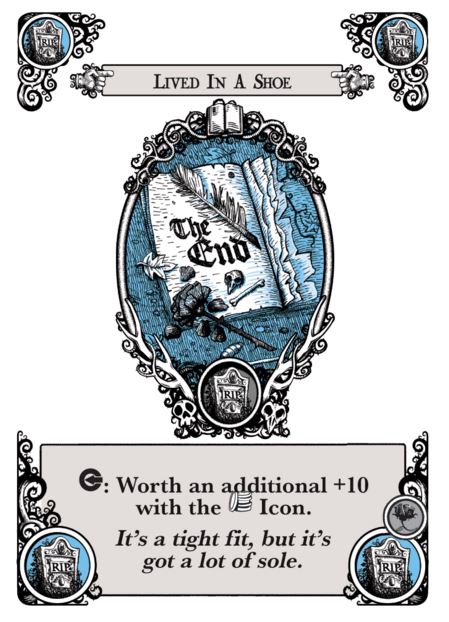
Fairytale Gloom, by Atlas Games, is part of their Gloom series but is standalone and doesn't require the other versions of Gloom or familiarity with them. Here are some of the game cards. There are definitely familiar fairy tales included.

The biggest criticism I am seeing for the game is that it is better to play with creative people. That is my same observation with my beloved Dixit. It's my family's favorite game but when I tried it with a bunch of teenagers, it wasn't as successful. Not a failure, just not as creatively fun as when my family (ranging in ages from 8 to 69) plays it.




Game description:

The Game of Grim Incidents
and Unhappily-Ever-Afters

A fairytale toad in a prince's crownLet's face it: Fairy tales are awful. Wolves and old women eat children, giants fall from the sky, and even young girls break-and-enter to steal porridge from unsuspecting families.

In Fairytale Gloom, custom collections of fairy tale characters like Jack, Gretel, Puss in Boots, and Little Red Riding Hood do their best to stay happy, but circumstances conspire to rain woe on their sad, benighted heads.

These heroes become beasts, give up on Grandma, and cry wolf once too often. Even though they look into magic mirrors and kill golden geese, most end their days living in giant shoes… or worse.

Eventually, enough Unhappy Endings come to pass that the game ends. And then? The most miserable collection of characters wins.

Fairytale Gloom is a stand-alone game that's also compatible with all existing Gloom core games and expansions.

In Fairytale Gloom…
Each player chooses their own collection of fairy tale protagonists.
Modifiers add or subtract points. You could play "Dwelt With Some Dwarfs" on "Rapunzel," for example.
Unhappy Endings lock in points for good or ill. Perhaps "Goldilocks" "Cried Wolf Once Too Often."
It's all about storytelling: Players weave tales around what comes to pass. What happened, exactly, when "Joe the Giant" "Married a Murderer?"
With transparent cards, the points you can see are the points in play — it's that simple!

Designer: Keith Baker | Artist: Jaume Fabregat
Stock Number: AG1332 | ISBN: 978-1-58978-158-0 | MSRP: $24.95 US
Format: Two decks of 55 transparent cards, and a rules sheet in a tuckbox
Release Date: June 2015

Friday, October 23, 2015

Crafty Friday: Fairy Tale Sewing: 20 Whimsical Toys, Dolls and Softies by Heidi Boyd


Fairy Tale Sewing: 20 Whimsical Toys, Dolls and Softies by Heidi Boyd was released earlier this year.


As always, pictures speak louder than words when it comes to crafts. You can click on the images below to see them larger.

Book description:

Sew your way to happily ever after! Bring story time to life with this collection of imaginative projects. Drawing inspiration from classic fairy tales, author Heidi Boyd adds a modern twist to everything from huggable softies such as the magical Unicorn to interactive toys such as Snow White's Cottage Tote. Sleeping Beauty's Castle Quilt brings sweet dreams to any child's room, and the Rapunzel Pillow is perfect for cuddling and play. Readily available cottons, felts, yarns and embroidery floss plus clear instructions and detailed illustrations make sewing simple and straightforward so you can spend less time sewing and more time enjoying your favorite fairy tales.


Thursday, January 29, 2015

Art Thursday: Fairy Tale Illustrations by John Lawson


Babes in the Woods

Today's art are color illustrations by John Lawson for the book, There Was Once: Grandma's Stories, by Mrs. Oscar Wilde published circa 1890. 

Cinderella

Grandma's Stories

Jack the Giant Killer

Little Red Riding Hood

Puss in Boots

The Three Bears

Art Credit: All Prints (chromolitho), Lawson, John (19th century) / Private Collection / © Look and Learn / Bridgeman Images

Wednesday, August 20, 2014

New Book: Puss & Boots by Ayano Imai


Puss & Boots by Ayano Imai was released in May of this year here in the states. This has become one of my favorite picture book versions of Puss in Boots--note it is Puss & Boots here, for this one's different. And also a little harder to find in a book search with the clever word play. Oh well.


The story isn't quite the usual Puss in Boots but I like this version a lot. There's a shoemaker this time. And lots of boots of different sizes. And it is beautifully illustrated.


Book description:

A beloved fairy tale reimagined

A poor shoemaker must close his business as there is no work, but his cat is determined to save the shoemaker from his plight. Using a magnificent pair of boots and a sly plan, the trusty cat tempts a monster and tricks the beast into using his own vanity against himself. With the monster defeated, the shoemaker reopens his shop and can once again sell his beautiful shoes to the townspeople. A beautifully distinctive retelling of a classic tale, this children’s book features enchanting illustrations from acclaimed artist Ayano Imai.


Pssst. You can click on the images to see them larger and read some of the text.