Showing posts with label Cupid and Psyche. Show all posts

Friday, April 26, 2019

New Book: Echo North by Joanna Ruth Meyer


Echo North by Joanna Ruth Meyer was released earlier this year. It is a definite catnip book for many of us with inspiration drawing from East of the Sun and West of the Moon, Beauty and the Beast, Tam Lin, and Cupid and Psyche.

Book description:

Echo Alkaev’s safe and carefully structured world falls apart when her father leaves for the city and mysteriously disappears. Believing he is lost forever, Echo is shocked to find him half-frozen in the winter forest six months later, guarded by a strange talking wolf―the same creature who attacked her as a child. The wolf presents Echo with an ultimatum: if she lives with him for one year, he will ensure her father makes it home safely. But there is more to the wolf than Echo realizes.

In his enchanted house beneath a mountain, each room must be sewn together to keep the home from unraveling, and something new and dark and strange lies behind every door. When centuries-old secrets unfold, Echo discovers a magical library full of books- turned-mirrors, and a young man named Hal who is trapped inside of them. As the year ticks by, the rooms begin to disappear and Echo must solve the mystery of the wolf’s enchantment before her time is up otherwise Echo, the wolf, and Hal will be lost forever.

Saturday, July 15, 2017

Bargain Ebook: Sun and Moon, Ice and Snow by Jessica Day George for $1.99


Sun and Moon, Ice and Snow by Jessica Day George is on sale for $1.99 in ebook format.

The book retells East of the Sun and West of the Moon, a Beauty and the Beast tale. And one of my favorites. And the tale helps one to understand how Cupid and Psyche is a Beauty and the Beast tale, this is the bridge story between the two.

Book description:

Blessed-or cursed-with an ability to understand animals, the Lass (as she's known to her family) has always been an oddball. And when an isbjorn (polar bear) seeks her out, and promises that her family will become rich if only the Lass will accompany him to his castle, she doesn't hesitate. But the bear is not what he seems, nor is his castle, which is made of ice and inhabited by a silent staff of servants. Only a grueling journey on the backs of the four winds will reveal the truth: the bear is really a prince who's been enchanted by a troll queen, and the Lass must come up with a way to free him before he's forced to marry a troll princess.

Thursday, May 25, 2017

Cupid and Psyche at the Thorvaldsen Museum in Copenhagen, Demark


One of my favorite artistic mediums is sculpture which is fitting since my husband has discovered a budding talent for just that in the last few years. He is chagrined that it is one of the few visual art mediums he didn't study in school but has found it is one of his best. So May 2nd was a banner day since we probably saw more sculptures than we have ever seen in a 24 hour period. 

We started our day with a visit to the Thorvaldsen Museum in Copenhagen. Bertel Thorvaldsen is one of our favorite sculptors. Our first day in Copenhagen and within hours of arrival we went to see Thorvaldsen's Christus and Apostles statues at the Church of Our Lady, the cathedral of Copenhagen. So we had already had a wonderful experience with his work. That was a meal. His museum was a feast. 


But what about Hans Christian Andersen and fairy tales? Well, actually, this was a favorite day for me with very little HCA or so I thought. I actually learned that Thorvaldsen and Andersen were good friends. In fact, Andersen was one of the last to spend time with Thorvaldsen before Thorvaldsen's death. From Wikipedia:

Towards the end of 1843 he was prohibited from working for medical reasons, but he began to work again in January 1844. His last composition from 24 March was a sketch for a statue of the genie in chalk on a blackboard. At night he had dinner with his friends Adam Oehlenschläger and H. C. Andersen, and he is said to have referred to the finished museum saying: "Now I can die whenever it is time, because Bindesbøll has finished my tomb."

After the meal he went to the Copenhagen Royal Theatre where he died suddenly from a heart attack. He had bequeathed a great part of his fortune for the building and endowment of a museum in Copenhagen, and left instructions to fill it with all his collection of works of art and the models for all his sculptures, a very large collection, exhibited to the greatest possible advantage. Thorvaldsen is buried in the courtyard of this museum, under a bed of roses, by his own wish.
The museum has hosted a special exhibition about HCA previously (see Writing Is an Act of Love) and owns items about HCA, although none were on display. For example, you can read about Thorvaldsen and Hans Christian Andersen here and A Letter to Thorvaldsen from H. C. Andersen.

But enough about HCA for now. Don't worry. He'll return again in future travel posts. Now I want to turn to mythology and sculpture, especially some of Thorvaldsen's work centering around Cupid and Psyche, perhaps my favorite myth especially since it is a predecessor to East of the Sun and West of the Moon and Beauty and the Beast.


But first I had to share Heavenly Wisdom (1825). She was one of the first figures to greet me in the museum. We have an Athena in Nashville that is quite famous, but I found myself liking this thoughtful one with her little owl at her feet. It's a plaster version. The marble version is found in Saint Peter's in Rome.


As we continue, please note the photos are all my own with all their flaws and you can see them slightly larger by clicking on them. They have been sized down for the web. I am going to link to the piece's museum page where more details are provided and sometimes a better picture. The museum had both marble and plaster pieces. The plasters are always dirtier since they are more fragile but they still have some beauty to be seen.

First, from an information care at the museum, a summary of the Cupid and Psyche tale to remind us of the story.


Now some of Thorvaldsen's interpretations of the story scenes which provide "illustrations" of the story for us today.


Cupid Revives Psyche, 1810 This is beautiful, there is another version, too: Cupid Revives Psyche, 1810 which I like even better but I didn't see it in person to photograph it. The details are more refined in it. Gorgeous.


From the museum card:

After many inhuman ordeals, Psyche has at last found her Cupid again. In her hand she holds a chalice with the elixir of immortality that will render her divine like her lover, so the two can finally marry.


Bonus: I also fell in love with this Huntress on a Horse, 1834 that is a rare piece of classical inspired art that shows a woman in action. Even Athena, Goddess of War, is usually just standing still. Its companion piece of a male hunter was much more sedate in action, making it even more magical.


And finally, there were many, many, many Cupids fluttering around in marble and plaster in the museum, the cute cherub types. Those don't capture my fancy as much but this one made me laugh: Shepherdess with a Nest of Cupids, 1831.

From the museum card:

The small cupids represent various aspects of love: The cupid with his eyes closed represents slumbering love; those kissing represent active, ardent love; the cupid laying his head on the shepherdess’s arm is hoping for love; the one patting the dog represents constancy and the one flying away fleeting love. Perhaps the cupid that is not clearly seen represents secret love.
Finally, Thorvaldsen did several studies and other works of Cupid and Psyche, too. The museum site has some photos of the plasters and sketches. These are not as lovely to me since the plaster has deteriorated, but they provide a look into the artistic process. If this really interests you, search the site and see drawings and other works, too. For now see:

Cupid and the Sleeping Psyche, 1838

Another Cupid and the Sleeping Psyche, 1838

Psyche and Cupid, 1838 (waking Cupid)

Another Psyche and Cupid, 1838 (reunited perhaps?)

Tuesday, December 17, 2013

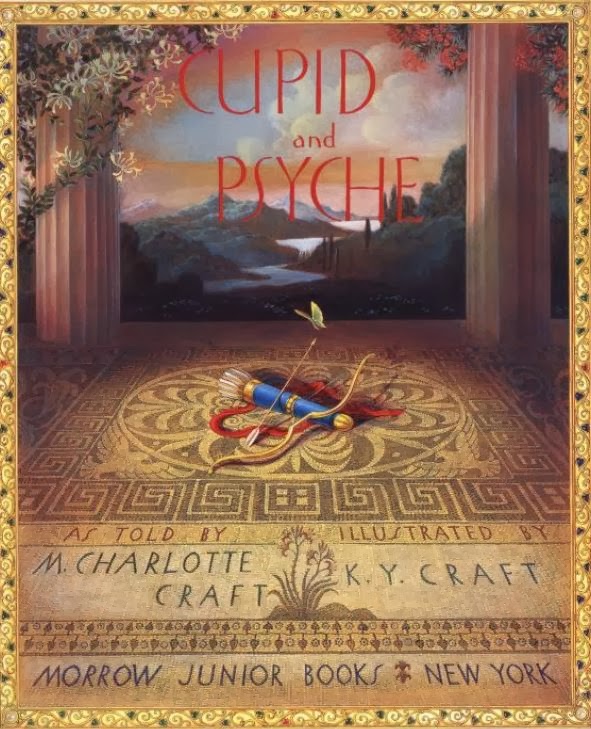
Cupid and Psyche by M. Charlotte Craft and Kinuko Y. Craft


(US / UK Links)

Cupid and Psyche by M. Charlotte Craft (Author) and Kinuko Y. Craft (Illustrator) is one of the Beauty and the Beast fairy tale titles still in print. There aren't many picture books of Cupid and Psyche to be found and this is a gorgeous option with Kinuko Craft's artwork. I've discussed the tale repeatedly here and its influence and importance in the ancestry of Beauty and the Beast. So I'll just sit back and let you enjoy the pictures today.


Book description:

Psyche is the most beautiful woman in the world, yet the oracle at Delphi foresees she will fall in love with a creature feared even by the gods themselves.

Magically, Psyche finds herself in a magnificent castle fitted with sweet music, attentive servants, and a charming but invisible host. Soon she falls in love with this man she has never seen, but in a moment of doubt she betrays his trust. To win back his love, Psyche must show that she is as brave as she is beautiful by performing three impossible tasks.

Perhaps the greatest love story of all, Cupid and Psyche is unsurpassed in its richness and drama. Marie Craft's lively, suspenseful retelling of this classic Greek myth will appeal to young and old alike. And these legendary lovers have inspired forty lush luminous paintings by award-winning artist Kinuko Craft.

Lavishly illustrated and thrillingly told, here is a book to be treasured forever.


Thursday, October 10, 2013

Repost: Heidi's Wishlist: Psyche Revived by Cupid's Kiss


I originally posted this almost a year ago and thought it would be fitting to share again today since I discussed Cupid and Psyche earlier. Still don't know if I am going to acquire this statue.... 


Eros (Cupid) & Psyche by Antonio Canova Greek Roman Mythology Lovers Statue, Marble Finish 11-inch is another item on my personal wishlist. The statue is actually titled Psyche Revived by Cupid's Kiss.


There are a few pieces of art in the world that are beloved by many. While it sometimes feels trite to love them when they are so popular, there are some that have such power that no apologies can really be expected. And, of course, several of these are in the Louvre. No, I don't mean the Mona Lisa. She leaves me cold. But Cupid and Psyche by Antonio Canova and the Victory of Samothrace are two of my favorites. Another favorite is the Unicorn Tapestries in the Cloisters in New York. Their power over me quite shocked me but that is another entry for another day.


I have been to see the real Canova piece in the Louvre several times, but this is a wonderful statue and I hope to see it many more times. Since I am currently working on Beauty and the Beast Tales from Around the World, Cupid and Psyche is particularly frequent in my thinking these days. I've always been drawn to these ATU 425 tales more than any other so I am really loving working on this book.


These images are my own from my 2008 trip. It is so hard to get good pictures of this piece because it is large, it's corner can be dark, and it is usually swamped by tourists. I am actually surprised I got photos this good, although my desired close-up studies overall turned out too blurry to share. In these situations, I'm an amateur photographer and tired tourist with a basic touristy camera trying to get some shots before someone jostles me or steps into my view range. Very frustrating. But the statue makes me forget.


The statue may have to be my reward for when I finish the Beauty and the Beast tales book. And if you, too, love Cupid and Psyche in art, I highly recommend The Tale of Cupid and Psyche: An Illustrated History. It costs more than the replica statue, but it is a pleasure.

Cupid and Psyche and Beauty and the Beast


So far, in my discussion about Beauty and the Beast Tales From Around the World (and ebook link), I have talked about the early history of the tale and the versions by Villeneuve and Beaumont. I have also been busily updating the Beauty and the Beast and East of the Sun and West of the Moon pages at SurLaLune. I am very much behind, but the History of Beauty and the Beast and Tales Similar to Beauty and the Beast pages are pretty much done. Of course, these will be supplemented by the same pages on East of the Sun once I have completed those updates. The Beauty and the Beast Bibliography is also under reconstruction and about a third of the way done.

To sum up, we've established that Beauty and the Beast is firmly a literary tale with definite, traceable origins. But hey, this is folklore. Things are never that simple. Because writers have been drawing inspiration forever from artistic creations that preceded them and folklore, especially myth and fairy tales, has been a primary source for just as long.

So for today, we go back, way back, in history to the second century A.D. to what can be considered one of the genesis--if not the genesis--Animal Bridegroom tale. Absolutes are always open for debate and I'm not starting one here.

Again, from my introduction to Beauty and the Beast Tales From Around the World:

Although there are valid arguments for some Greek and Roman myths as sources—such as the stories of “Zeus and Semele,” “Europa and Zeus,” and “Kallisto and Zeus”—they require complicated analysis for comparing to Beauty and the Beast. One of the best discussions about early mythic Beauties and Beasts can be found in Graham Anderson’s Fairytale in the Ancient World (2000).

The earliest traceable literary source for Beauty and the Beast is the story of Cupid and Psyche. The tale appears in Metamorphoses, commonly known as The Golden Ass, written by Apuleius in the second century AD. Cupid and Psyche is the best known and most enduring story from The Golden Ass. Speculation over Apuleius’s work supposes that he, too, derived the story from an earlier source. Examples of Cupid and Psyche appear in visual art centuries prior to Apuleius, but no literary examples exist, either because they never did or because they have been lost in the ravages of history. An excellent compendium and study of the tale can be found in The Tale of Cupid and Psyche: An Illustrated History (2002) by Sonia Cavicchioli. Whatever Apuleius’s influences may have been, his version of Cupid and Psyche is the one that primarily influenced future literary and artistic interpretations of the tale for the two millennia that followed, especially when it was embraced during the Renaissance and after.

Cupid and Psyche—of which two versions are offered in this collection, one a direct translation of Apuleius—shares many elements with Beauty and the Beast, but the stories are quite different. In truth, Cupid and Psyche has influenced a large range of Animal Bridegroom tales—as they are commonly labeled—and Beauty and the Beast tales are only a small, albeit very popular, portion. 


Anderson discusses Cupid and Psyche the most in his chapter on Beauty and the Beast, but he also has some useful discussion of other myths I listed above. I didn't include those myths in my book since the connections are rather tenuous and other stories gained priority. They would be included in a companion book if I do it.

A quick read of a version of Cupid and Psyche for children--if you are not overly familiar with the tale--may be helpful since it is a quick read although significantly shorter than the original. The story has been interpreted and referenced over and over again. I've collected a nice library of poetry and visual art over the years.

Significant things to note about Cupid and Psyche--he's a god, not a beast. But the story elements are so influential that there is no doubt about it being part of the Animal Bridegroom folktale type. Also, Psyche is rather frustratingly stupid at times. While the heroine grows and makes less mistakes as the story progresses in other tales of this type, Psyche makes mistakes pretty much up to the end although her heart is in the right place. There is certainly the air of myth instead of fairy tale to the story, for the humans have to be lesser than the gods.

Tuesday, October 1, 2013

Beauty and the Beast: Recommended Reading Part I


One of the challenges of discussing Beauty and the Beast is figuring out where to begin. Beauty and the Beast Tales From Around the World is an anthology that helps you explore the history of the tale with a relatively short introduction considering the massive size of the book. It was tempting to write a much longer introduction but it was important to stay with the main objective--to share the tales--especially since there are some wonderful books already published that discuss the tale in much greater depth.

So today, I'm going to recommend other books, not my own. The ones that were important tools for me during my hunt for tale after tale. And the ones that allowed me to say, "Don't write that, refer your readers to the greater analysis available in _________."

In other words, if you are an avid Beauty and the Beast fan, these books need to be in your library.


The Tale of Cupid and Psyche: An Illustrated History by Sonia Cavicchioli is quite simply a gorgeous book. You can own it for the artwork alone, never reading a word. But it also includes wonderful discussion of the story that essentially started it all, Cupid and Psyche, which I will be discussing in greater depth in future days. The book includes a version of the tale and an overview of it's appearance throughout history with some solid analytical discussion, too.

Book description:

Once upon a time there lived a king and queen who had three very beautiful daughters....It was only just possible to find words of praise for the elder two and to express the breath-taking loveliness of the youngest...was beyond all power of human speech. Every day thousands of her father's subjects came to gaze at her, foreigners too, and were so dumbfounded by the sight that they paid her the homage due to the Goddess Venus alone.

The passionate love story of a god and an exquisitely beautiful mortal woman, the myth of Cupid and Psyche has fascinated Western culture since the Middle Ages. First appearing as a long aside in Apuleius's The Golden Ass in the second century AD, this romance has inspired countless works of art in an astonishingly wide range of media. Gathered here is a selection of these numerous works, from monumental fresco cycles, to easel paintings and wedding chests, from miniatures, tapestries, and stained-glass windows, to marble and porcelain sculptures. Many are considered masterpieces of European art.

The sheer number and beauty of the works this myth has inspired is a testament to the power and richness of the story. The lovers are often portrayed as children to suggest their eternal youth and immortality. In some scenes they are shown kissing, in others, tormenting each other, expressing the extremes of joy and suffering that beset all lovers. The changing tastes and sensibilities of different periods are reflected in Psyche's appearance, evolving from courtly and Baroque to neoclassical and Pre-Raphaelite. For the modern age, it is the dual nature of Cupid and Psyche's love, on the one hand deeply spiritual, and on the other intensely sensual, that has resonated most powerfully.

"It seems," noted Walter Pater, the nineteenth-century British critic, of Apuleius's story, "that one can see and touch the blond hair, the fresh flowers, the precious works of art of which he speaks." Thanks to the extraordinary artworks included in this book, we can indeed see, if not touch, the splendors of Apuleius's story. 96 color illustrations, 128 in b/w.


The next book is The Tale of Cupid and Psyche by Jan-Ojvind Swahn. Published in 1955, it is long out of print and somewhat rare but not impossible to find by any means. I have owned a copy for several years and mine was uncut--that was an evening of fun, cutting fragile pages and creating paper dust and bits everywhere! But this is the full study of ATU 425 tales, those most closely related to Beauty and the Beast (which is ATU 425C). Similar in nature to Marian Roalfe Cox's Cinderella, Swahn analyzes in great detail over 1,000 variants of the tale with a survey table that consists of 30% of the book. Many have never been translated into English and a large percentage have never been published in any language but exist in manuscript collections.

Many of the tales in Beauty and the Beast Tales From Around the World are listed by Swahn, although my book includes others he either dismissed or missed. The scope of my book also goes beyond ATU 425 to other Animal Bridegroom stories. But the work is impressive, especially with it done before the age of computer tools. And it is a way to compare and understand the expanse of this tale type.

I also translated a few into English that I have never seen translated previously, but again, that's for future days on the blog.

And, wow, I still want to build a database of tales. That project is coming someday. Whenever I get the personal bandwidth and funding to support it. I've been dreaming about it for years....

These aren't all of the books--I'll be sharing more tomorrow, so stay tuned.